
Ten months.
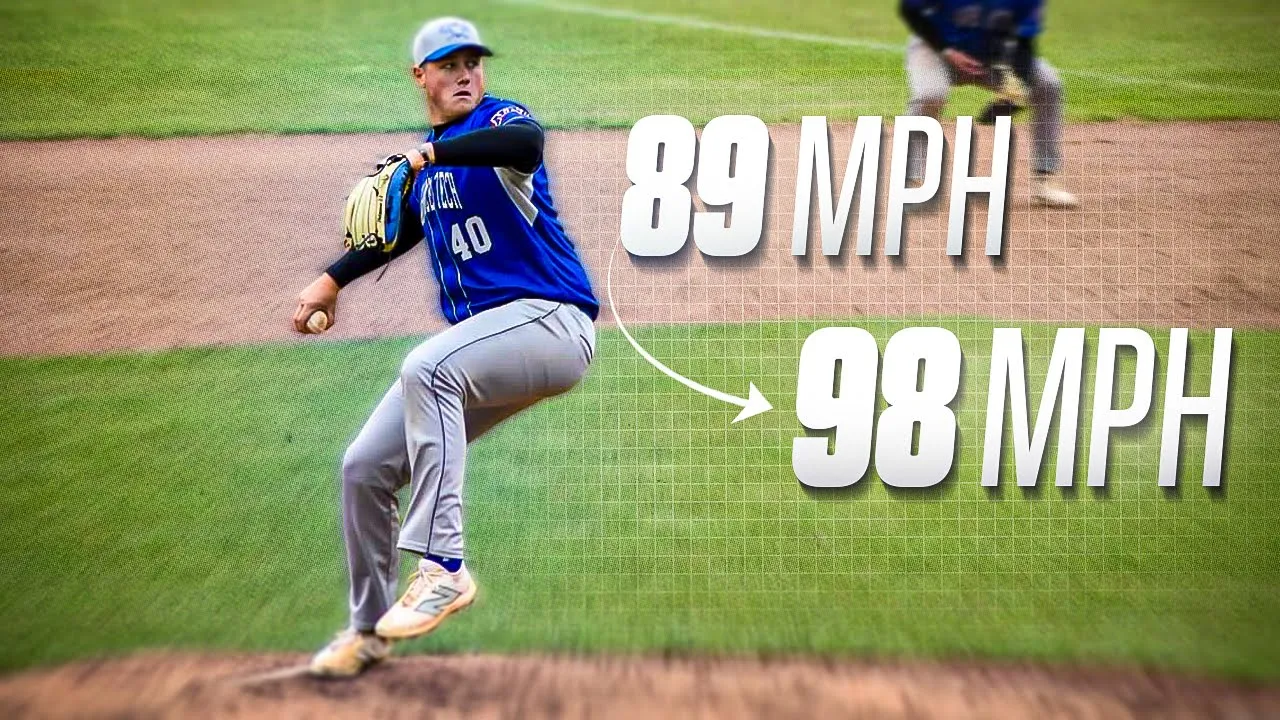
That’s all it took for Ethan Hochendoner to go from an anonymous NAIA arm to a legitimate professional prospect.
You can watch the full breakdown in this video, or keep reading below for the complete story.
The Intake Form That Made Me Laugh
I had to read Ethan’s intake form twice.
When asked what he was struggling with, he wrote: “I’m not struggling. I just want to throw a little bit harder and keep building off the foundation I currently have with my arsenal and strike throwing abilities.”
Fair enough.
Looking at his stats, he clearly had no issue throwing strikes. The command was there. The pitchability was there.
The problem? He got hit around.
At 6’7″ and 260 lbs, Ethan had the physical tools that make scouts salivate. But topping 90 mph wasn’t going to get it done – especially not for a guy built like that.
He just needed to figure out how to actually use what he had.
What the Assessment Showed
Ethan signed up at the end of March, right in the middle of his spring season.
Before we even talked about drills or programming, I needed to understand what was actually going on in his delivery.
I could’ve pointed out 50 different flaws, but they all traced back to the very beginning of the throw. A poor first move that caused a cascade of compensations down the line.
The breakdown:
When he got into leg lift, he didn’t really go anywhere. Major lack of drift as he reached peak leg lift. He wasn’t starting to move forward until he was already heading down the mound.
His back leg dumped toward third base at peak leg lift, then he compensated by swinging his front leg open. At the same time, the throwing arm got way behind him, creating this power-T position like a human turnstile.
He landed with his front foot wide open.
By the time he got into the actual throw, his upper half had to work overtime to correct itself.
When he lifted his leg, he went one way. Going down the mound, he had to fight to get back the other way.
Not an efficient way to throw a baseball.
The scary part? This is incredibly common for big guys who never got proper instruction early on.
The good part? When you’re this inefficient and you clean it up, the gains can be massive.
In-Season: Don’t Overcomplicate It
With Ethan in the middle of his competitive season, I wasn’t about to give him a laundry list of mechanical changes that would mess him up and keep him from competing.
This is where a lot of coaches get it wrong.
They see all the problems and want to fix everything at once. That’s a recipe for disaster when a guy needs to go out and compete every week.
Ethan was also brand new to throwing plyo balls. He’d never done a structured plyo routine before.
So I kept it extremely simple.
Two feels. That’s it.
For the upper half: relax the arm. I gave him the pendulum drill to feel gravity pull the arm down and back up, capturing the momentum so he didn’t get stuck behind him.
For the lower half: get off the quad and get a little more linear to home plate to reduce compensations later in the throw.
Through April, we didn’t discuss mechanics much. Ethan sent me game video start to start, and we talked pitching. How to make adjustments between innings, when to throw certain pitches, sequencing, etc. I wanted to make sure he understood how to actually get hitters out.
He threw a complete game and topped 91 for a new PR that month.
The good sign? His plyo work was having a positive effect.
Remote Training: Trial and Error
When May rolled around and the spring season ended, we could really start testing different feels.
This is where the real work happened.
And it’s the part nobody wants to talk about because it’s messy, iterative, and doesn’t lend itself to clean social media posts.
Remote trial and error is tough because the feedback loop is over 24 hours. I give Ethan a cue, he tries it the next day, sends me video, then I respond with what looked good, what to stick with, and what to try differently.
Ethan was awesome throughout this process. He sent me videos every single day.
That’s what it takes to make remote training actually work.
The feel that really clicked was talking about a more elbow-driven flip with the arm.
He had this very hand-driven philosophy. When he broke his hands, he’d immediately take his hand way behind him and have a really long, inefficient arm action through the rest of the throw.
By cueing a more elbow-driven flip, “don’t worry about getting your hand up, worry about getting your elbow up”, it kept the arm shorter and allowed him to capture that momentum a lot better.
What stood out to me in the first video he sent was how much his arm avoided external rotation. He really liked keeping his hand on top of the ball.
That gave me clues.
That late layback was going to be what worked for him.
Around this same time, we worked on some lower-half feels- the same concept as the upper half. He didn’t like ER in the hips, really preferred to internally rotate.
We leaned into that and saw some solid results.
First Velocity Phase
June came around, and it was time for Ethan’s first velo phase.
The first thing we did was pulldowns, and I love these for guys who have a hard time tapping into maximum intent. It’s really just about feeling what it’s like to throw the ball hard for the first time.
Ethan had never done them before, so it was a little rough in the beginning.
That’s expected.
But he got up to 94 mph the first time.
The message he sent me: “That’s the hardest I’ve ever thrown in my entire life.”
That’s the whole point of pulldowns! Show your body that you’re capable of throwing this hard. Give it a reference point.
Around this time, Ethan told me he was really starting to enjoy the plyo routine around the IR back leg and the IR arm action. He leaned into those things and ended up getting his pulldowns up to 97 mph.
Another good sign that the throw was becoming more efficient and he was starting to feel and understand these things.
He finished the pulldown phase at the end of June.
Into July, we deloaded and got into the plyo testing phase. Basically just throwing plyos hard two days a week, and seeing if we could get the numbers to go up each week.
Through the plyo testing phase, I made sure to give him more athletic drills to feel quick and explosive now that his patterns were going to allow him to actually move fast.
He grabbed 95 mph with a 3.5-ounce ball.
At the end of that phase, he threw a bullpen and hit 92 mph, which at the time was a bullpen PR.
The Pivot: Competition Over Velocity
As August hit, Ethan was getting ready to go back to school, where he’d have to compete in the fall and potentially throw for pro scouts.
We finished the velo phase, deloaded, and pivoted away from velocity work entirely.
Next, we started talking pitch design, trying to get all his pitches working correctly.
At this point, Ethan said he’d never felt more confident about his mechanics. He went through the fall throwing in intrasquads every week.
He also sat 90 mph for the first time ever in a pen.
Another great sign.
Anyone who knows me knows I don’t care about the ceiling that much. I care about the floor.
Seeing that floor go up to 90 mph, his previous PR, was an excellent sign that we were on the right track.
Through September, we talked about simple adjustments after his intrasquad outings. Not talking about velo through August and September, just letting him compete and do his thing.
This is important: you can’t chase velo year-round.
At some point, you have to let guys compete and pitch.
The Breakthrough
October came around. Fall finished, and Ethan was fired up for another velo phase.
This is when he really started to pop.
We reviewed all the game footage and determined that the lower half wasn’t nearly as explosive as it could be. Now that he was out of competition and wouldn’t have to compete again for several months, I wasn’t worried about some mechanical tinkering.
The plan was to do a full trial-and-error phase to see if we could get a little more velo out.
This is when I introduced Ethan to lateral tilt in his throw.
The reason I wanted to give Ethan some lateral tilt: typically, when I give guys this feel, the guys who are too rotational, it makes their delivery automatically a lot more linear.
Adding lateral tilt is a high-level move and can be really tough to feel, so it’s not something I wanted to give him early.
Now that we knew the arm action was in a better spot, I felt confident he’d be able to pick this up quickly.
And he absolutely did.
The drills:
A rocker with lateral tilt. I told him to get that front foot up off the ground, then try to tilt everything back. “Try to dip into the velo bucket,” as I told him, and come out of it a lot more explosively than before.
We paired that with a step-back where his center mass was just in front of his back foot, then adding a little lateral tilt.
The key: as he tilted backwards, he was actually moving forward very linearly down the mound.
With the shorter arm action, he was going to be able to rotate very quickly and pull his long throwing arm through much quicker than he had before.
We worked with plyos for just a couple of weeks, then got into a mound velocity phase.
The mound velocity phase was overload/underload mound velos.
A 6-oz ball, a 5-oz ball, and a 4-oz ball. We paired that with 1 mph pens, which is basically just starting at around 85 mph, trying to go 1 mph up at a time, so he really could understand where velo comes from, throwing “hard-easy” with efficient sequencing.
In that first 1 mph pen, Ethan sent me a text: “I just hit 94.8 mph.”
I’ll be honest, I didn’t even believe him.
The first thing I asked was, “Did you get it on video?”
He said no.
His next velo day was the next Friday, and Ethan hit 95.4 mph on that day.
And thankfully, he did send me a video of that one.
The next week, he ran it up to 95.9 mph.
He did one more velo day, and it was slightly down, so we went ahead and took a deload. It’s very important if you’re finding new velos to take some time off because your body’s never experienced this before, and it can be very stressful.
In my mind, it was far more important to make sure he recovered from that than to get greedy and push through a down week.
The Life-Changing Moment
Shortly after this, Ethan asked me about playing professional baseball after school for the first time.
This was such a cool moment for me.
I didn’t really think about it when he hit 95 mph, but when he asked me what playing baseball after school would look like for him, that’s when I realized this guy has had life-changing gains here.
“He was at an NAIA school, throwing 88 to 90 mph. Really just an average pitcher in NAIA. Now he’s throwing 95 mph and thinking about playing professional baseball for the first time.”
In an era where NAIA arms rarely get looks, much less contracts, Ethan was suddenly in the conversation.
That’s what this is all about.
He also booked a trip to Tread for the beginning of January.
Through December, wetook our foot off the gas a little, stayed lighter, and just built him up for his week here at Tread.
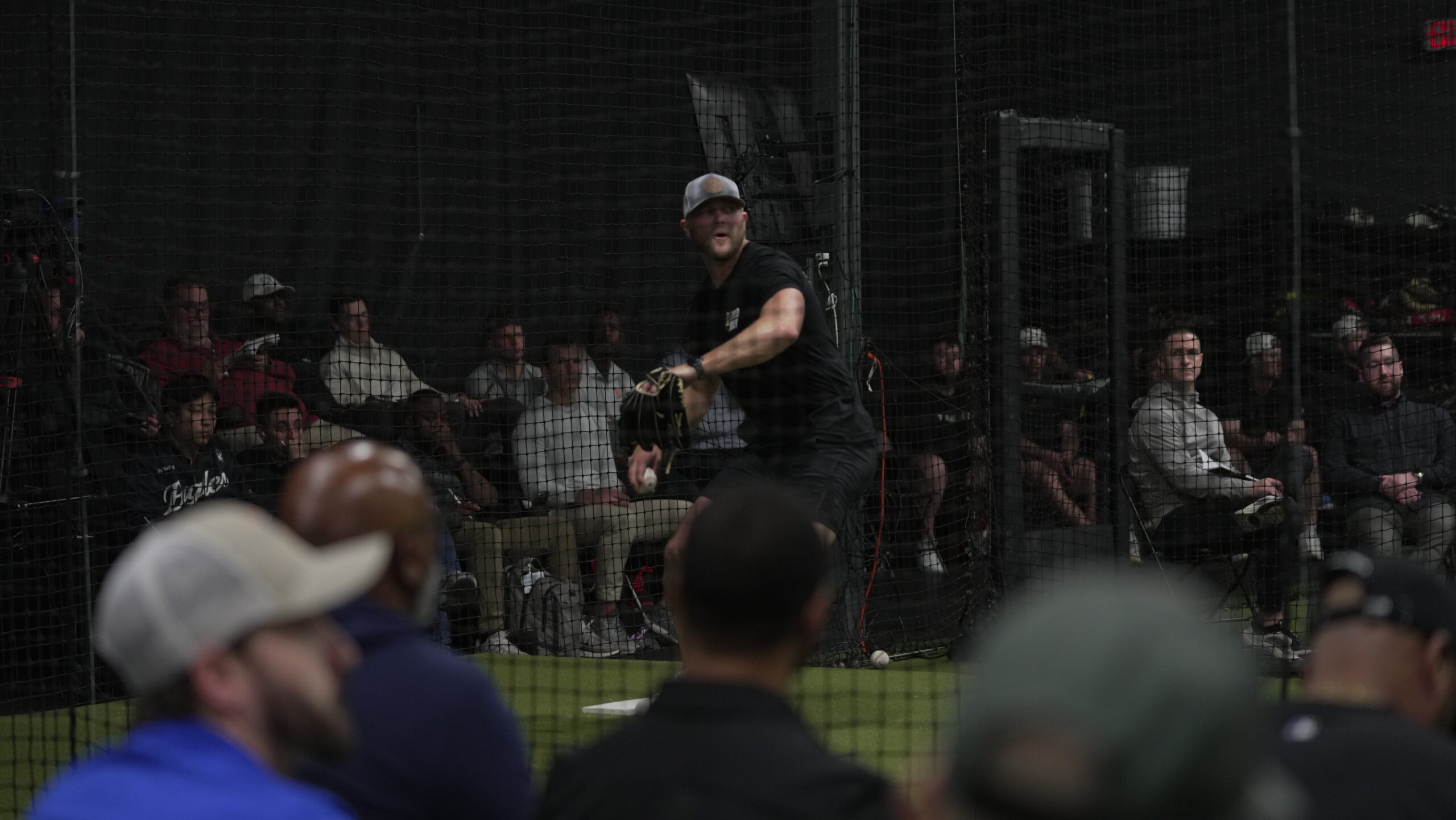
When you come to Tread, it’s kind of like a showcase. We’re going to have video rolling everywhere; you’ll get all your data, and we can send all of this to scouts.
I made sure to tell Ethan: make sure when you come out here, you’re ready to rip and do some really cool stuff, because we’re going to get the word out about you at this point.
The Trip to Tread HQ
Ethan was only going to be here for one week, so he was only going to get two bullpens.
That first bullpen, we wanted to keep it pretty light, get on motion capture and review his mechanics.
But the big day came on that Thursday when I told him, “Hey, let’s do something cool today.”
He came out sitting 96 mph and ran it up to 98 mph indoors.
Unbelievable for anybody, much less an NAIA pitcher who was sitting 88 mph ten months ago.
On this 98 mph throw from Ethan, you can see all the improvements he made.
As he comes out of leg lift, he’s got that lateral tilt going. He’s got that pelvis and those shoulders matching plane. On the lower half, you can really see that his direction is cleaned up a ton.
It’s still a little bit off, so that could get cleaned up a little more.
Which is kind of scary because he might throw 100 mph.
All of that stuff has come together really well. The way he gets the arm in position to get pulled through by the torso is great. That was the biggest thing he cleaned up: getting that torso to rotate quicker with a more efficient lower half and making sure the arm is in the right spot at that moment.
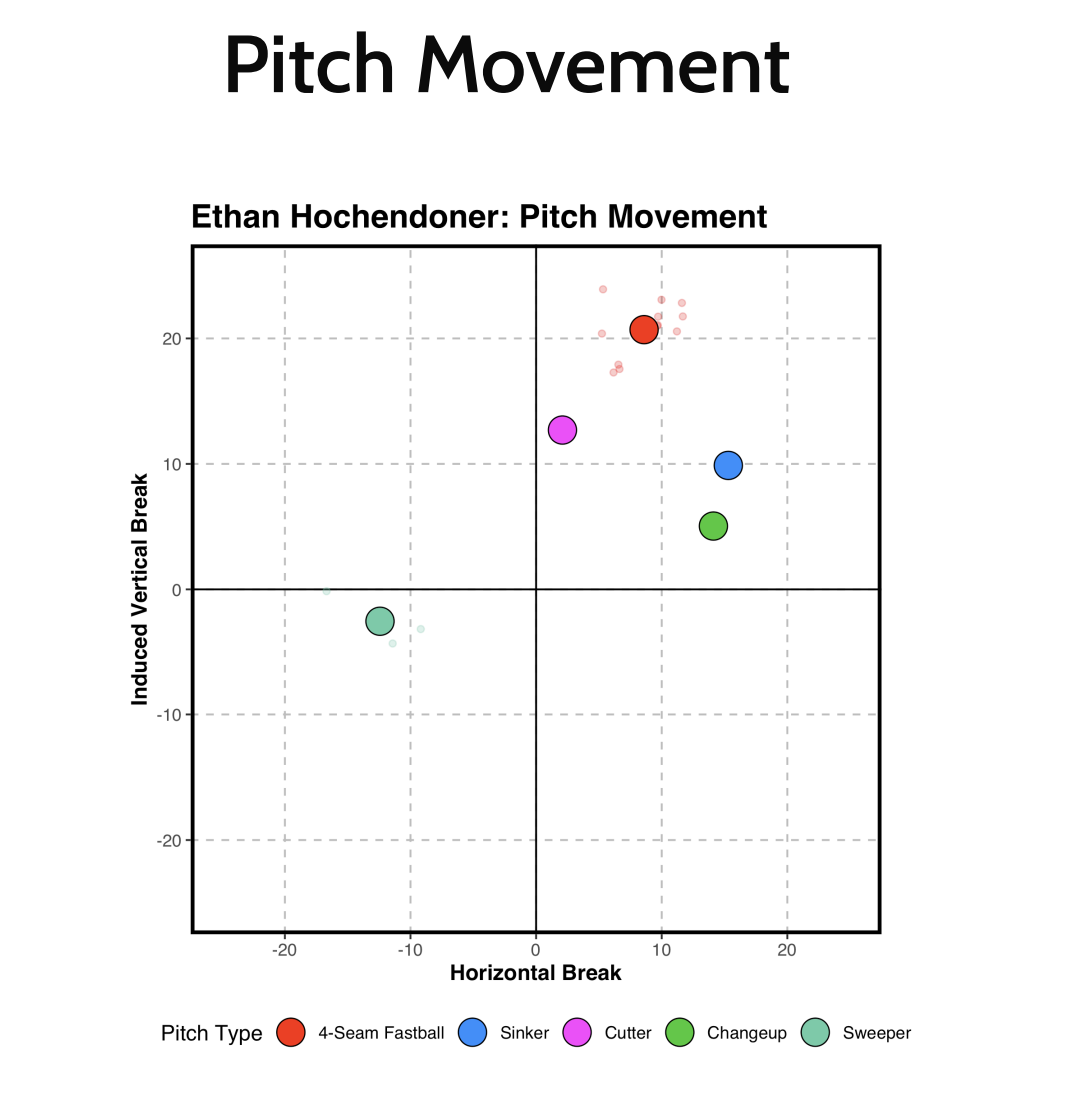
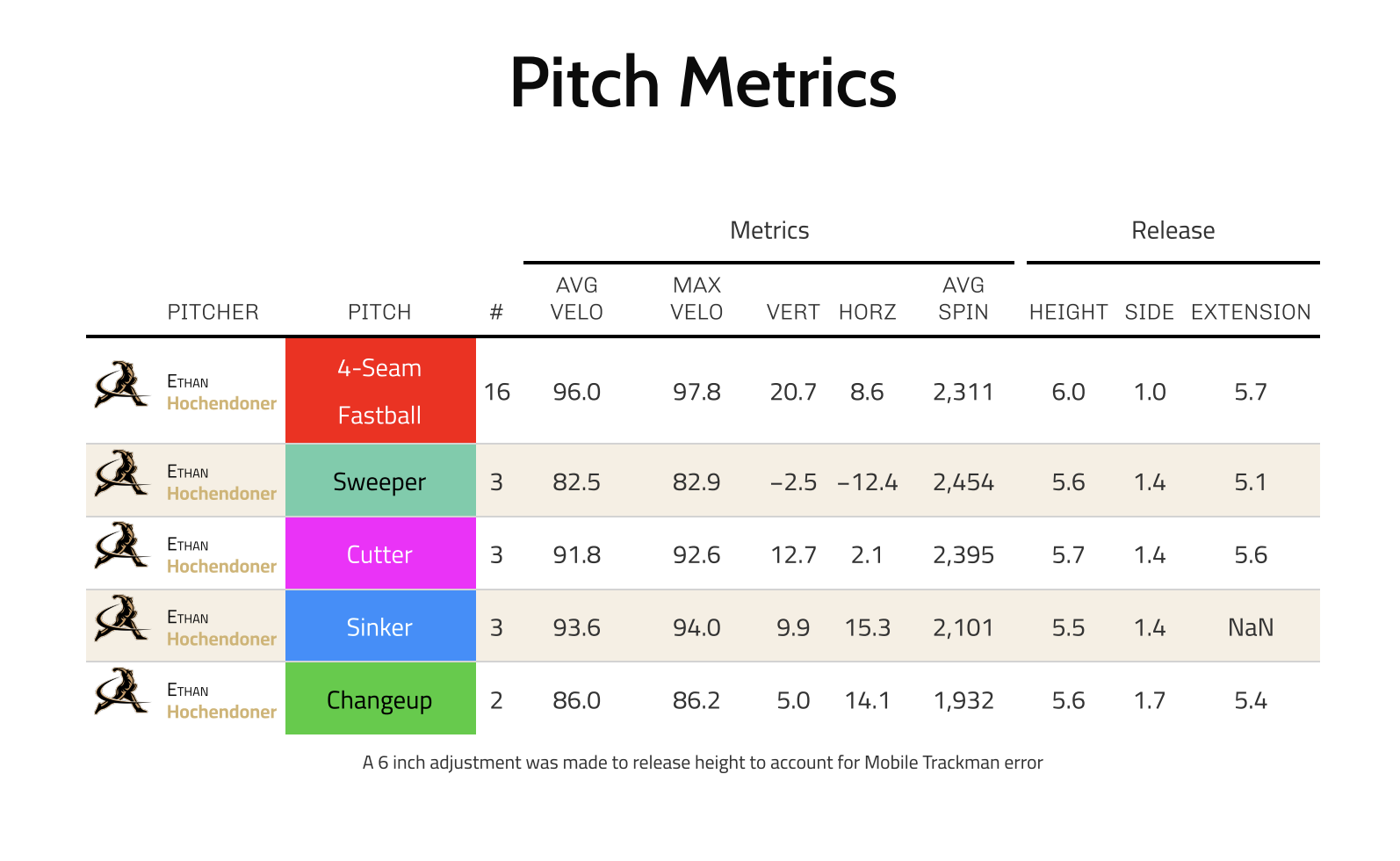
The other thing: he threw strikes the whole time, and all his other pitches were nasty.
Obviously, the biggest story here is the velo. But the fact that he was throwing all these fastballs in the zone after finding all this velo was a really cool thing.
He’s always been a strike thrower; he just needed the velo.
The other bonus: all his offspeed pitches were really solid. Take a look at his movement plots below:
What Made This Work
I’m super excited for Ethan and his future.
These are life-changing gains.
But when you’re as big as Ethan, and you have as many flaws in the throw as he did, and you clean those up, you can absolutely do something just like this.
Here’s what actually made this work:
1. He sent video every single day.
The coolest part about this whole thing to me: Ethan made 90% of these gains remotely.
He did such a good job of sending me video. He would actually overwhelm me with video sometimes. But that’s what you have to do if you’re going to have success in a remote program.
Give your coach as much information as possible.
2. He executed on the full program.
Let’s not forget that all the other things he did in his Tread programming – the mobility, the nutrition, the weight room – he executed on all of those things as well, and those contributed to his gains.
Velo doesn’t come from just the throw. It comes from building capacity across the board.
3. We were patient with the process.
We didn’t try to fix everything at once. We stuck with the plan, adjusted when needed, and let the work compound over time.
That’s what separates guys who make gains from guys who program hop.
What’s Next
Just under a year ago, Ethan was sitting in the upper-80s heading into his senior season as an NAIA pitcher.
Now we’re talking about how to talk to pro scouts.
If you don’t think a lot can happen in ten months, just ask Ethan.
From an anonymous NAIA arm to 98 mph and fielding pro questions.
That’s what rewriting your story looks like.