
Mastering The Mental Game [Click To Read]
Read time: 2 min
Let’s imagine two scenarios that all of us have experienced.
In the first scenario, you step onto the field feeling untouchable.
You are a machine on the mound.
Automatic.
The plate looks huge, and you feel like the catcher is 10 feet closer than normal. You effortlessly drop breaking balls wherever you want, and your fastball? Forget about it.
Your mind is clear. Confident. You are the aggressor.
Pitching feels easy – like something you’ve done your whole life.

Some days pitching feels like a video game.
The next game you feel off, but you can’t quite pinpoint why.
Maybe I’m flying open?
You labor through 3 innings before giving up a leadoff home run and walking the next batter on four pitches.
Why won’t the umpire give me a break!
You start to get pissed, and the next two pitches are nowhere close to the zone.
You can feel the game – and your mechanics – speeding up on you. Your mind jumps back to the home run you just gave up – and you just hope you can find a way to escape this inning.
The plate feels like it’s 90 feet away, and you can’t silence the negative emotions racing through your head.
Every pitcher can relate to both of these scenarios.
Most of us are aware that the mental game matters, but it becomes an illusive topic that few coaches or players devote time to – rarely even 5-10 minutes per week!
Some pitchers gradually figure these concepts out through experience – as they learn what does and doesn’t work when pitching under pressure. But many don’t even begin to tap into the mental game by the time their careers are over.
This guide seeks to expose you to the basics of mental training and to give you a framework for developing a weekly mental practice.
Let’s dive in.
Why Is Mental Training Important? [Click To Read]
Read time: 3-4 min
In a time where pitchers and coaches are hyper-focused on developing velocity, stuff and pitch metrics, we sometimes forget about the end goal – getting hitters out.
While these things are critical, it’s much harder to quantify what’s going on between the ears. The mental game, however, is every bit as important.
In their book, Foundations of Sport and Exercise Psychology, Robert Weinberg and Daniel Gould report the majority of coaches believe sports performance is at least 50% mental (and as high as 80-90% in sports like golf and tennis), when opponents have similar physical capabilities.
Phrased differently for those of us who aren’t good with numbers:

The mind’s role in performance only increases as competition stiffens, and the majority of coaches understand how critical mental skills are to optimal athletic performance. Despite this, few actually take the steps necessary to incorporate it into their practice or training plans.
The beautiful thing about this paradox is that it gives you (the athlete) agency, autonomy, and control in this hugely important aspect of your development, if you’re willing to put in the work to develop your mental skills.
Pitchability & The Mental Game
Now, this doesn’t mean that the physical side isn’t massively important. But at the highest level, all of these guys are strong, all of them are powerful, and all of them throw hard / have nasty stuff. There are some guys who are simply better due to their physical characteristics – the Aroldis Chapman’s and the Shohei Ohtani’s of the world.

You probably aren’t as genetically gifted as Aroldis Chapman.
However, for the majority of players, these differences start to flatten out. In many cases, you can’t see a huge difference between Big Leaguers and Minor Leaguers if you were to watch a few pitches from a bullpen at our facility.
Both guys throw 95, both guys have electric off-speed pitches. Both guys are strong and powerful.
What separates them, at that point, is their “Pitchability” or skill as a pitcher – of which the mental/psychological component is a massive piece.

While a few pitches in a bullpen wouldn’t help you identify the big leaguer from the minor leaguer, watching a couple full bullpens or a couple full outings allows the differences to shine through. By and large, what we’ve found is that
- MLB pitchers deal with pressure better – they aren’t shaken out of their zone easily
- MLB pitchers are more consistently in the strike zone with everything
- MLB pitchers can make quicker mental (and therefore physical) adjustments
- MLB pitchers have more well-defined routines that they stick to
- On average, MLB pitchers have slightly better stuff
Note that while stuff is extremely important, once everyone is throwing 96, throwing 97 doesn’t help your performance as much as taking your pitchability from 30th percentile to 70th percentile. This is really what the “90% mental, 10% physical” comments are pointing to.
Whatever the exact percentage the mental side accounts for – the bottom line is that it’s an important piece to include in your preparation.
Let’s begin to introduce some of the ways in which to do just that.
Playing One Pitch At A Time [Click To Read]
Read time: 5 min
The “Flow” State
Flow is a state in which a person becomes so immersed in an activity that nothing else seems to matter. It is a culmination of skills and challenge, total concentration, sense of control, a lack of self-scrutiny, and intrinsic enjoyment.
Think back to that first scenario in the introductory section where you felt dominant and in total control.
How much better would you be if you were able to find that “Flow state” just 10% more of the time? What about 50% more of the time?
Entering flow was originally believed to be out of an athlete’s control. A growing body of evidence, however, including athlete interviews, shows that entering flow is at least partially controllable. Flow occurs on a continuum, which requires individual adjustments throughout practice or competition.
We have some control over getting into this flow state – the question is: how?
Mindfulness – Playing One Pitch at a Time
Mindfulness is an overarching theme that you will hear throughout this course – and that you have undoubtedly heard at some point in your baseball career.
Think of mindfulness as a way to create awareness of the present moment – in other words, to play one pitch at a time.
Mindfulness centers around two core concepts: awareness and acceptance.
First, it’s being aware of the thoughts, feelings, emotions and sensations that are occurring in your mind and body. For example, recognizing that you’re starting to get frustrated after a bad call by the umpire.
Second, it’s being able to accept those thoughts or feelings, without judgment.
In other words, being able to separate yourself from thoughts or emotions that don’t serve you in the moment.

If your initial reaction is that this sounds like some Far East, Monk-like philosophy that has no relevance pitching – that was my first thought too when I was introduced to it as a player.
However, it actually is how the best pitchers in the world are able to bounce back so fast from a bad pitch, a bad inning, or a bad start, even if they don’t realize they’re doing it.
Mindfulness is a lot harder than it sounds, and for most of us will require significant practice to master. None of us have 100% control over what thoughts, sensations or emotions choose to pop into our heads, but with mindfulness training, we can have more control over how we identify, react and respond to those thoughts.
The very best pitchers still have thoughts of doubt, anxiety, etc., but they are more able to stay in the present moment and refocus on the next pitch, rather than letting those occasional thoughts derail their entire outing.
Traditional Mental Training vs Mindfulness
Traditional mental training is often based around trying to eliminate or eradicate negative thoughts and emotions, whereas mindfulness training allow athletes to recognize and accept emotions in a non-judgmental way.
Let’s say you’re on the mound and the following thought pops into your head: “oh crap, I just gave up a leadoff walk. Why does this always happen?”
Traditional approaches might advocate that you focus on eliminating or controlling this negative thought.
A mindfulness approach would involve recognizing the thought, and rather than trying to control it, simply accepting it and re-centering oneself on the task at hand using the breath or other mindfulness strategies.
The late, legendary (baseball) mental skills coach Dr. Ken Ravizza advocated for a mental skills approach that was centered around “freedom, clarification of mission, present focus, letting go of control, and transcending the ego.” This approach to training and developing mental skills allows athletes to completely immerse themselves in the present moment, one pitch at a time.

The acquisition of mindfulness through mental skills training will improve your ability to recognize what arousal level you perform best at, how to monitor and enter your optimal state of arousal during training and competition, and how to perform moment to moment, without judgment, allowing you to transcend your physical abilities.
A Competitive Advantage
Thirteen-time NBA Champion Phil Jackson, who holds the record for most NBA titles as a coach, was crowned with the moniker “Zen Master” for successfully implementing mindfulness training with his teams. His use of mindfulness is credited by Michael Jordan and Kobe Bryant as “helping teammates close in on [their] own level of awareness.”
Listen to him describe this practice:
Pete Carroll, USC and Seattle Seahawks coach, won two NCAA national championships and a Super Bowl using mindfulness techniques by purposely “immersing his players in distractions and chaos” to train them to “quiet their mind”.
Carroll preached to his team to focus on “what is right in front of you as if it’s the most important thing in the world.” Russell Wilson attributed this mindful preparation to helping him feel more relaxed during games, while offensive tackle Russell Okung believes mindfulness training carries the same level of importance to his all-pro success as tactical practice and weight training.
Members of Carroll’s Super Bowl-winning Seahawks team credited mindfulness so much for their success that they nicknamed it their “Ohm Field Advantage,” giving a nod to a popular refrain used during transcendental meditation.
Summary
Mindfulness training can help athletes recognize and accept changes in thoughts, emotions, physical feelings, tension, focus, and in-game momentum. This awareness improves the ability to focus on the task at hand, which places an athlete in a mental state conducive for entering a Flow state.
For you, that means mindfully making the best pitch within your ability, each and every moment, regardless of what has previously occurred. Through mindfulness training, our goal is to provide you with the ammunition needed to play one pitch at a time.
References
- Csikszentmihalyi, 1990
- Anderson et. al., 2014; Chavez, 2008; Jackson, 1992 & 1995; Swann et. al., 2012)
- Delehanty, 2014
- Roenigk, 2013
- Gardner & Moore, 2004, 2007, 2016; Janelle, 1999; Wegner, 1994
- Janelle, 1999; Wegner, 1994
- Ravizza, 2002
Part 1: Downloads & Worksheets [Click to read]
We have prepared 2 resources which are also part of the course. *NOTE: These are best viewed on desktop*.
#1: Mental Skills Worksheets (link)
While we recommend printing these out and completing by hand, you may also save the worksheets as a word document and complete them on your computer, or hit file > make a copy so that you can edit it directly as a Google Doc. You do not need to complete the exercises in the packet right now.
#2: Pitching Personality Profile (Excel, Sheets)
Please download and complete this assessment, which will give you insights on your specific ideal mental state on the mound.
If you have Microsoft Excel: on your computer/phone, open ‘Personality_Profile_Excel_Only_.xlsx’ down below and complete the assessment within Excel.

If you don’t have Microsoft Excel: please download ‘Personality_Profile_Google_Sheets’ down below and open it with Google Sheets. You may then complete the assessment.

If you are still confused, here’s a Step-By-Step tutorial on how to open and complete the Personality Profile.
Pitching Personality Profile [Click to read]
If you haven’t already, please download the Pitching Personality Profile spreadsheet (attached below) and complete the questions on the first tab. It is recommended to do this on your computer, rather than phone.
These questions will be related to your best performances, unique personality and preferences.
The first tab will look like this once completed. From there, click ‘view your results’.

The second tab will spit out a unique profile that will look something like this:

This profile assigns you a score across 6 dimensions.
- Mindfulness – how self aware are you? An excessively low score may indicate you could become more in tune with your body, while an excessively high score might indicate you’re overly in tune with your body and internally focused while on the mound.
- Adaptable vs. Structured – how routine oriented are you?
- Calm vs. Amped Up – at what level of arousal do you perform your best?
- Tense vs. Loose – do you perform best with higher or lower levels of physical tension?
- Carefree vs. Serious – do you perform best when you are having fun or dialed in?
- Relaxed vs. Aggressive – Your ideal demeanor on the mound. Focused & relaxed or angry & aggressive?
There is no pass/fail and a higher score in one area or another is not necessarily better – the idea is to bring awareness to what your individual style is, and then expose you to specific tools to maintain this state on the mound.
For example, Pete Fairbanks had a turning point in his career when he dialed in his mental state. He describes how there is an “ideal state” where he reminds himself to attack the strike zone and stay aggressive but isn’t overly angry or excessively amped up.
Another of our MLB pitchers texted me this after a solid outing: 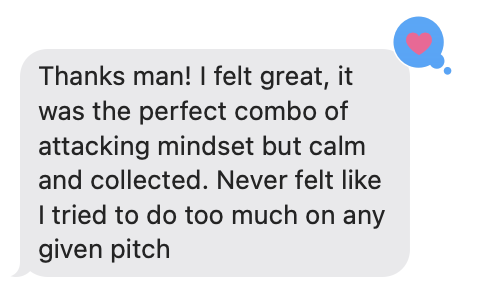
This is the sweet spot we’re talking about – and it requires gaining an understanding over time of your own unique preferences.
The following sections will dive further into each of these specific personality dimensions, and give sample tools you can use to steer yourself back to this sweet spot pre-game or in-game.
Let’s begin.
Please watch the entire presentation above. When finished, you may proceed to the next section.
Exercise 3: Pitching Personality Profile
After finishing the presentation, take a moment to complete the corresponding worksheet in your packet. This will help you reflect on your ideal pitching personality and what you’ve learned about yourself after watching through each of these sections and completing the profile.
Do Routines Work? [Click to read]
Read time: 2-4 min
How many times have you gotten 2 quick outs only to fall behind and walk the next batter on 4 or 5 pitches?
Conversely, how many times have you been able to bear down and battle through a 10 or 12 pitch at bat where you just continue to pour in strike after strike – 8,9 or 10 in a row?
These scenarios demonstrate the power of the mental game – and how it can totally derail or turn around an at-bat depending on how you handle it.
Your pre-pitch routine is about being able to get in that consistent mental state where you play one pitch at a time and treat each pitch as the most important pitch of your career.
If you’re like most pitchers, you probably have heard that routines are important somewhere along the way. Maybe you’ve been directly exposed to much of the information here, or maybe all of it will be completely new.
Either way, my experience is that most pitchers that are exposed to routines don’t fully buy in and apply it to themselves right away. Even if your current method is working, I’d ask that you approach this section with an open mind and an intent to make at least 1 tangible upgrade to your existing set of practices.
Routines are common across athletes of all sports, but the first question you’re probably wondering is do they actually work? And if so, why?
Do routines work?
While there is limited research on pitching specifically, there is actually some great info on routines in other sports, namely basketball free-throw shooting.
These are closed, self-paced motor skills, just like pitching.
In other words, the pitcher controls the pace of play, and the underlying task doesn’t change drastically from pitch to pitch. There is a fixed mound distance/slope, plate width, etc.
What changes is the surrounding environment itself (crowd noise, game situation, pressure, etc.), not the underlying task of delivering a 5oz baseball down a fixed slope to a catcher 60 feet, 6 inches away with a well-defined strike zone.
These similarities make research on free-throw shooting potentially useful. Both tasks involve performing a relatively closed skill with tons of external distractions/stimuli.
Here is what research on free throw shooting routines says:
- Amongst NBA players with pre-existing routines, this study found that when players deviated from their routines, those shots dropped in accuracy from 83 to 71%. That’s a 12% drop in accuracy when not sticking to their existing routine.
- In other research, pre-shot routines have shown improvements in free-throw shooting ranging from +6% in practice to a whopping +23% when under pressure (1,2).
Our experience is that it is typical to see increases in strike % by 5-10% or more for pitchers who do not otherwise use & regularly practice a pre-pitch routine.
Given that most outings are defined by a handful of pitches, this has the potential to be a massive difference-maker.
A 50% strike thrower is wild. A 60% strike-thrower can compete. A 70% strike-thrower has the potential to be elite.
If there is no routine in place, starting here to improve consistency is far lower hanging fruit than changing mechanics.
My Experience
Personally, I wasn’t exposed to pre-pitch routines until freshman year of college, and I fully bought in. As a low-mid 80’s D1 pitcher, I needed any advantage I could get at that time.
I had atrociously inconsistent mechanics. I was changing things all of the time. But I found a way to compete when I got in the game primarily by leaning into my routine. I was able to repeat these bad mechanics well enough simply by using my breathing, focus and routine.
This is similar to the free-throw shooter who has poor form, but is brutally consistent anyway because he focuses and repeats this “bad form” so well.

Do mechanics matter? Of course.
Good timing, good direction, etc. can all improve your consistency + command. But a good routine, or lack thereof, will add or subtract from this consistency.
And the best part?
It’s 100% within your control.
What if I already have a routine?
You may already have a pre-pitch routine, but ask yourself if your adherence to this routine is as consistent as you would like.
In the above study on NBA players, these players all had routines, but what they failed to do was always stick to their dominant routines, which can have effects on performance if you subconsciously deviate from this routine in critical game situations.
Additionally, ask yourself if you regularly practice or work on your routine.
Many pitchers have been exposed to the concept of routines, but have not yet fully committed to performing and practicing their pre-pitch routines regularly.
Summary:
Routines show performance benefits in the research and are supported overwhelmingly by anecdotal evidence across a range of elite athletes and sports. Establishing and sticking to a routine can help improve consistency for pitchers, although there are still other factors such as mechanics that should be optimized.
Exercise 4: Your Pre-Pitch Routine
Please complete the corresponding exercise in your worksheet, entitled “Your Current Pre-Pitch Routine”
The Mechanism [Click To Read]
Read time: 3 min
Why do routines work? 🧐
While the exact mechanisms are unknown, the prevailing theory is that, because self-paced skills require considerable attentional control, a routine can direct attention away from irrelevant internal or external stimuli, as well as allowing the athlete to avoid conscious (as opposed to automatic) processing.
Researchers noted “Pre-performance routines can improve performance by helping athletes focus their attention, eliminate distractions, reduce anxiety, and enhance confidence.”
In plain english, the routine gives you something to focus on so that you’re not thinking about your mechanics, that leadoff walk, etc.
This frees up the automatic part of your brain to just act, and silences the overthinking, conscious part of your brain.
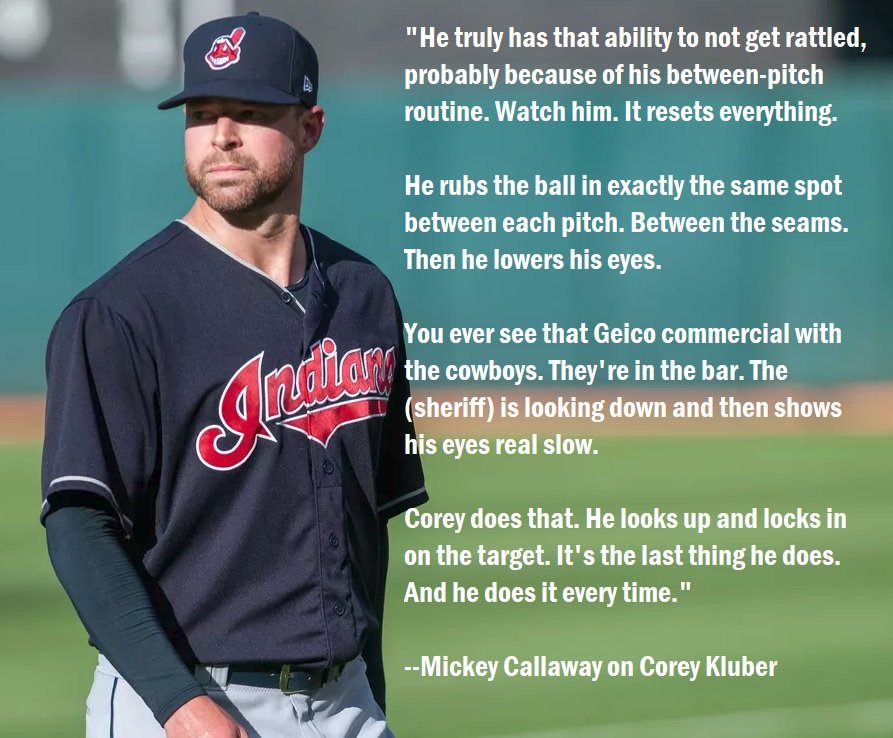
Finding “The Zone”, a.k.a. Flow State
Have you ever been in “The Zone” while pitching?
Where you were completely locked in to the present moment? How much easier is it to pitch when you’re in this state? What if you could be in that state every pitch?
Researchers sometimes call this the “Flow State,” and describe it as being
Fully immersed in a feeling of energized focus, full involvement, and enjoyment in the process of the activity. In essence, flow is characterized by the complete absorption in what one does, and a resulting transformation in one’s sense of time.(1)
Here’s Pedro Martinez explaining his version of being in the Zone:
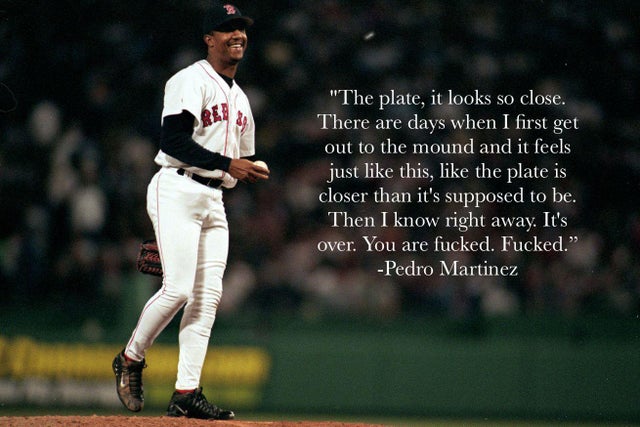
You wouldn’t want to face Pedro in the Flow State.
Watch this clip of Steve Nash describing his pre-shot routine.
According to NBA player Rick Barry,
“A routine enables you to not think about winning or losing the game. The focus is on the routine and not on the enormity of the situation.”
At the end of the day, this is the goal of adopting a pre-pitch routine.
Take a listen to Alan Jaeger describing the Flow or “Zone”
Summary: Routines give you something concrete and consistent to focus on to better direct your attention to the task at hand. This makes it more likely you will be able to enter a Flow State.
General Overview [Click to read]
Read time: 5-6 min
As humans, we are always in flux.
Paradoxically, pitchers can never repeat the same delivery in the exact same way twice.
This was proven decades ago by researcher Nikolai Bernstein, who observed that in blacksmiths doing a simple task like swinging a hammer, the hammer never took exactly the same path twice, despite hitting the target every time.
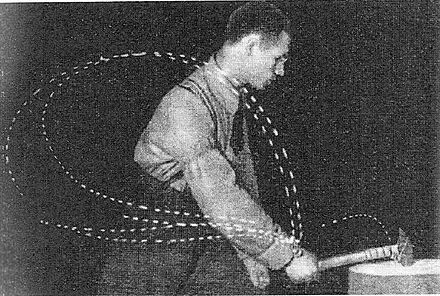
This is because there are so many ways (infinite, in fact) that we can move to achieve the end goal, that each movement is unique, even if it looks similar to the naked eye.
Despite this paradox, most great pitchers operate within a relatively narrow bandwidth.
Here’s Corbin Burnes demonstrating a high degree of overlap between his mechanics on different pitches.

Taking a look at a start from Burnes on July 1, 2023, we find that his release point only varied by roughly 2-3 inches on each pitch.
His release height on the curveball stayed between 72.5 and 74 inches.
His release height on the changeup stayed between 68 and 70 inches.
His release height on the cutter stayed between 70 and 73 inches.
What we now know from research is that, although pros are able to get to a relatively stable end point (release point/hand position), they are actually better at compensating in their mechanics to accomplish this than amateurs.
For example, let’s say the arm is starting to fatigue and the slot would otherwise start to drop. An elite player is able to compensate around this – whether that means tilting the trunk a couple more inches, flexing the elbow a couple more degrees, etc. While the end result (release point, pitch shapes and command) is the same (like the expert blacksmith hitting the target object every time), the way that they accomplish this has some built in variability.
So how does a routine help with this?
When the routine is consistent, your mental state pre-pitch will be more consistent. This will maximize the probability that you will be able to get to a relatively stable end point in your delivery and maintain your pitch shapes & command through the ups and downs of an outing.
Knowing that they will problem solve slightly differently every time to get to that relatively stable release point, the purpose of a pre-pitch routine is more so to get an athlete fully focused/present on the task at hand so that they can allow their body to freely express its movement capabilities.
The flow looks something like this:
Consistent Routine > Consistent Mental State > Fully Present/Attentive to Task > Consistent Output (some variability will exist to accomplish this output).
Your Routine As An Anchor ⚓️
The anchor analogy is another one that I use to explain routines to pitchers in simpler terms.
During a game there will be tons of thoughts racing through your mind, lots of changing variables in the game (baserunners, hits, fans yelling, fatigue, expectations, pressure, stress, etc.).
Your mind is like a ship at sea being jerked around by these thoughts (the wind, the waves, etc.).
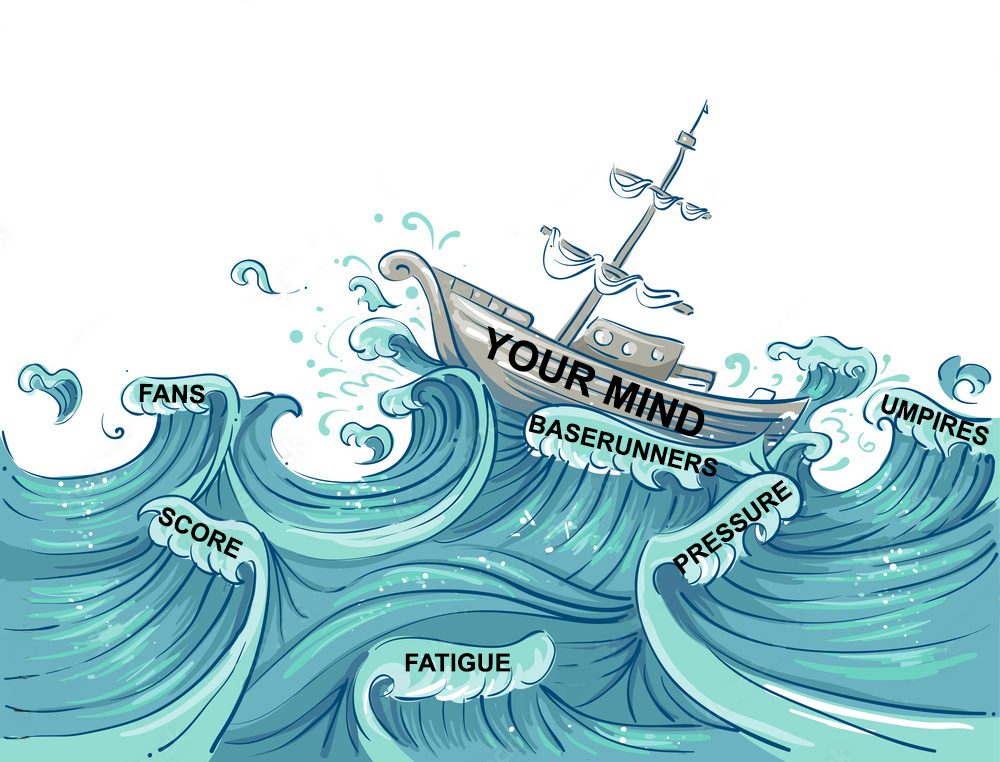
Your routine is like an anchor to keep the ship (your mind) steady as the game changes around you. It’s the constant that you can turn to and rely on no matter what happens in the game around you.
As one researcher stated,
“Routines help establish a sense of normalcy or familiarity in an often unpredictable environment.”
It’s worth noting that in non self-paced skills, routines may not be as important.
For example, at the free-throw line, basketball players have religious routines. But during normal gameplay, they must be able to react to the changing environment in seconds. They aren’t performing routines play to play – they’re reading the situation and reacting.
Pitching, in its nature, is much more like the free-throw shooting side of the equation.
Reacting to a come-backer, however, is much more of a reactionary part of the game for which you must be able to respond to wherever the play takes you.
Unlike in basketball though, this reactionary piece of the game (fielding your position) is a very small sliver of what being a pitcher entails.
The next section will discuss breathing as it relates to routines. In meditation, breathing is often described as an Anchor as well due to the fact that it is a constant that can be focused on at any point to re-center the mind. This is also how we will be using breathing, within the context of a broader and well-defined pre-pitch routine.
Building A Pre-Pitch Routine [Click To Read]
While there is no universally agreed upon framework for building a pre-pitch routine, this section seeks to lay out a simple framework upon which you can start.
The goal is that you ultimately customize this routine for yourself as you figure out exactly which pieces work for you.
Keep it Simple
Don Cooper, the White Sox pitching coach from 2002-2020 (I played in the org from 2014-16), had his own philosophy on pre-pitch routines, which he recited for the players in Spring Training of 2016.
What pitch are you throwing? Where are you going to throw it? Now try to throw it there with the best of your God-given ability. Once it leaves your hand, screw it.
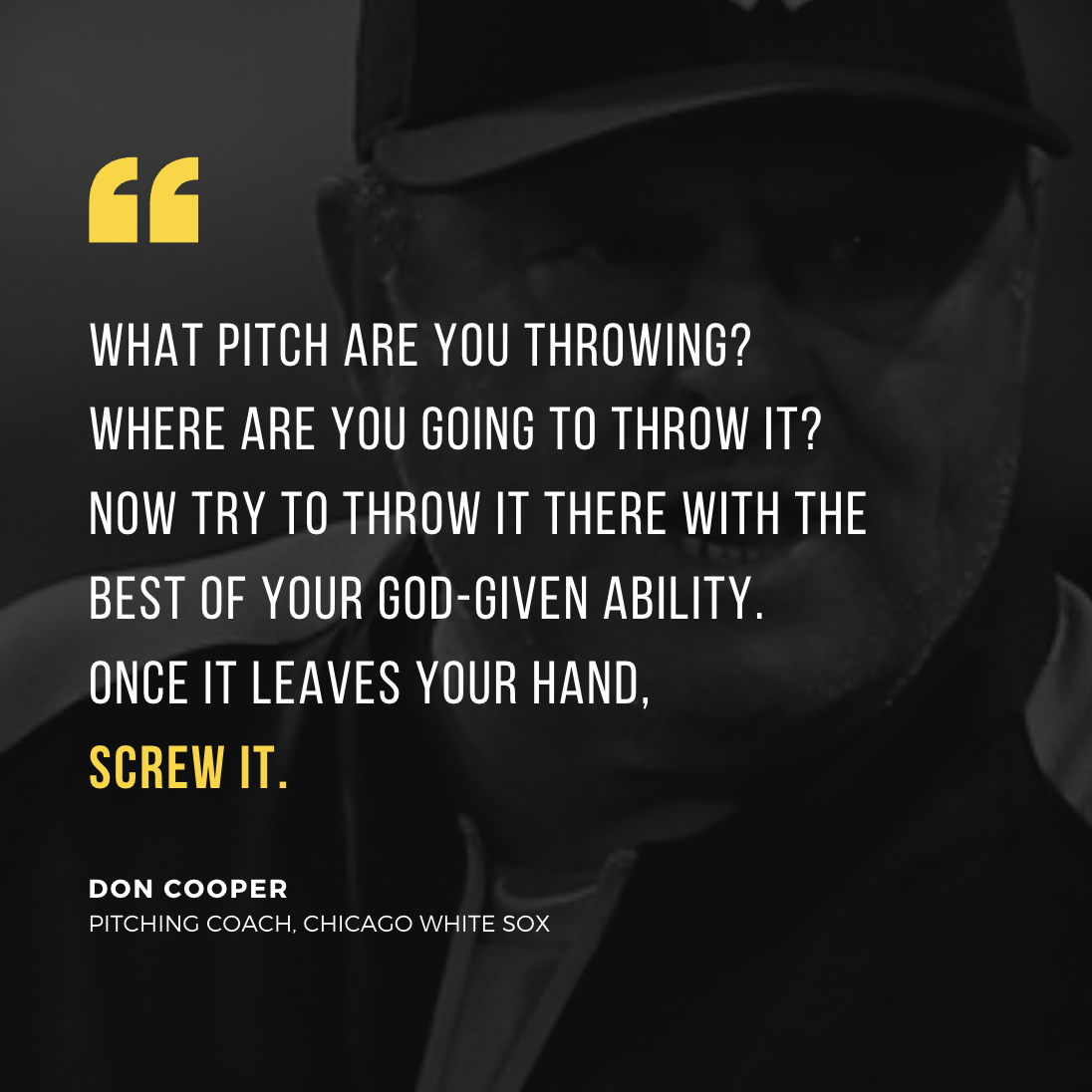
This encapsulates the idea in a simple way, and touches on a lot of key elements.
- Intention – coming up with a plan of attack and committing to it.
- Focal point / visualization – focusing on/visualizing where you’re going to throw the pitch.
- Attack – delivering the pitch to that focal point with conviction & trust in your ability.
- Flush – being able to move on from the previous pitch result, good or bad.
One piece which Cooper doesn’t touch on here is what I would call the Observe phase.
In the seconds after the pitch, the pitcher receives feedback. He may observe how the batter reacted to the pitch, if he missed/hit his spot, if he felt himself fly open, etc.
While not all feedback is relevant, pitchers can learn which feedback to pay attention to as it may influence the subsequent pitch if any micro-adjustments need to be made.
A Sample Pre-Pitch Routine
Below is a sample routine showing how this all comes together. I’ve included both the physical and mental sides of the routine.
Physical (general) are relatively fixed pieces of every pitcher’s routine, while physical (specific) refers to the mannerisms, tics, breath, etc. that are unique to each individual.
Mental refers to what is taking place between the ears from start to finish. I’ve also included a column showing how and where in this framework Don Cooper’s advice applies. You may find this easier to remember by using Don Cooper’s quote or coming up with your own variation on it.
The following chart is just for you to see what is happening on the physical/mental side from 0 to 20 seconds.
You don’t need to memorize this chart – I’m just breaking it down to illustrate that routines aren’t totally random processes.
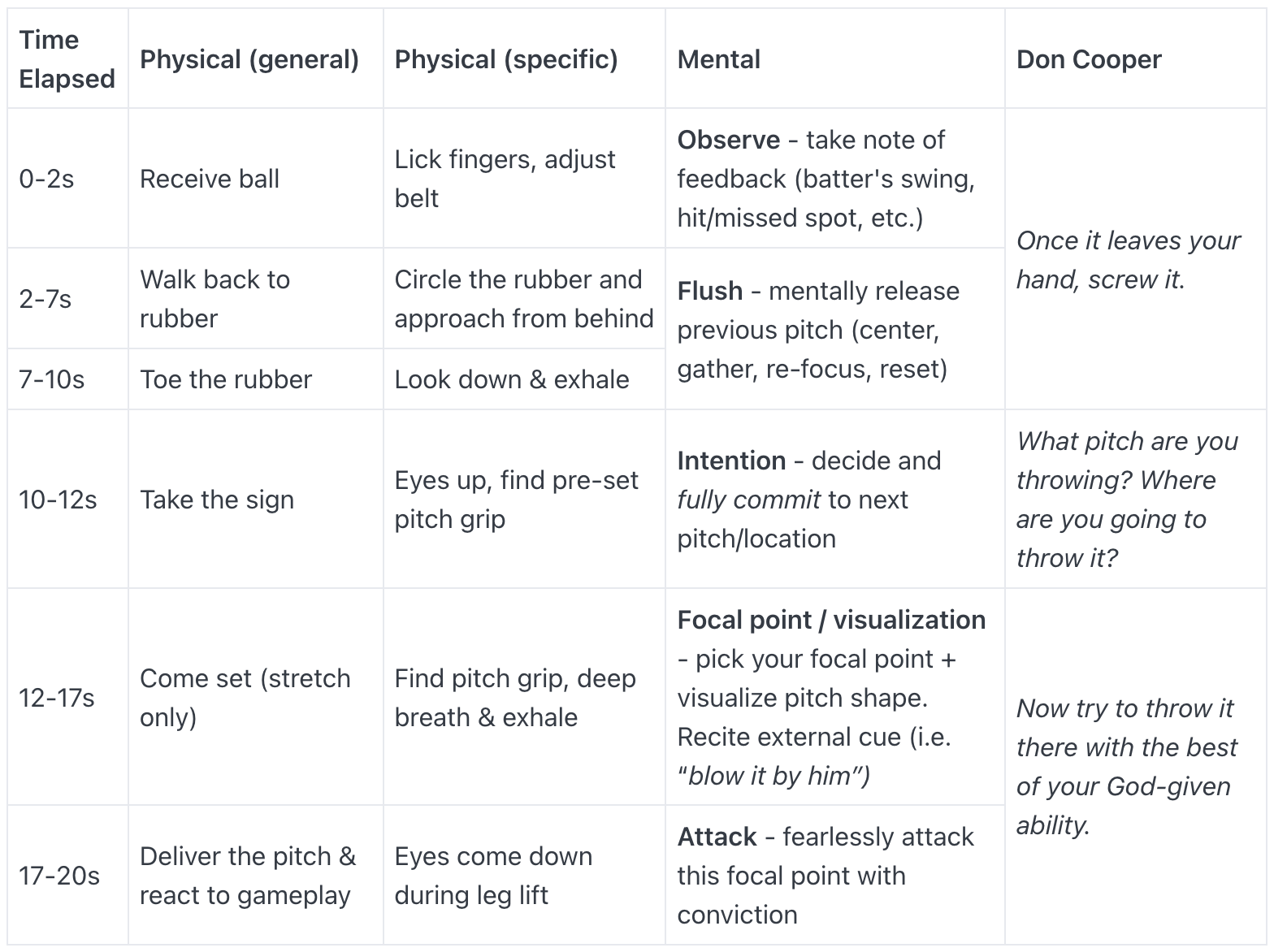
Don’t worry, we’ll break down each piece of this routine in the following sections. In most cases, pitchers are deficient in at least one of these areas (trouble flushing the previous pitch, or not fully committing to the pitch in the intention phase).
Summary: Your routine will help you stay as consistent as possible even as your mechanics and the game changes around you. It serves as a mental and physical anchor during the chaos. A good pre-pitch routine will be unique and comfortable, allowing you to flush the previous pitch and fully commit to the current pitch. Understanding the components: Observe, Flush, Intention, Visualization & Attack, will allow you to troubleshoot any area you may be lacking.
Observe [Click To Read]
Read time: 3 min
You’ve just released the pitch, and for the several seconds afterwards (assuming the ball is not put in play), you’re in the observe phase. ‘Crap, I missed my spot, now it’s a 3-2 count,’ you think to yourself.
I define the Observe phase as taking note of relevant information from the prior pitch, which may be useful in planning the next pitch.
This might include external information about the hitter (i.e. an ugly swing on a changeup) or internal information about yourself (feeling your front side yank open on that bounced curveball).
Remember, we want to be able to free ourselves up to compete, but we still need to have some general awareness of what is going on around us.
Some pitchers will be much more analytical in-game, while others will excel by tuning out a majority of this feedback and just focusing on executing whatever pitch the catcher calls next.
Over time you will find out what feedback to pay attention to before it becomes detrimental, and how much information you can realistically take in without it leading to paralysis by analysis.
Researchers call this Specifying vs Non-Specifying information. That lady in the stands waving to her friend is not something to you should pay attention to (non-specifying information), while the hitter moving up or back in the box may very well be worth observing and exploiting (specifying information).
How much thinking/observing should you do?
Compare and contrast Pedro Martinez’ approach of reading the hitter and carefully considering his game plan from pitch to pitch to Chris Sale’s approach of trusting the catcher and avoiding over-thinking.
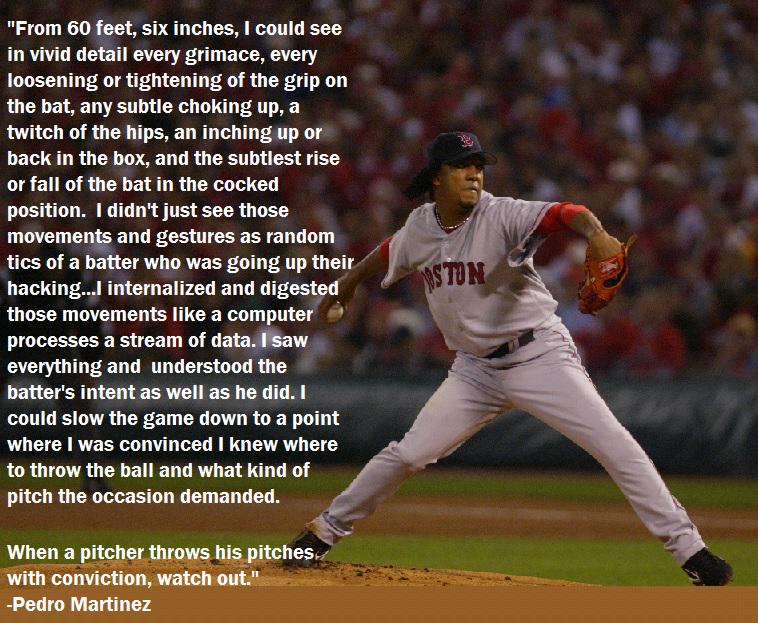
Read that last line again.
“When a pitcher throws his pitches with conviction, watch out.” –Pedro Martinez
Now listen to Chris Sale describe his approach ⬇️
Listen to that last line again.
“Just have all the confidence in the world in whatever you’re throwing.” -Chris Sale
That sure sounds a lot like Pedro, doesn’t it?
Both pitchers find a way to get that conviction prior to delivering the next pitch.
Pedro found it by picking apart hitters and relying on his own observations to arrive at a decision. This gave him his conviction.
Sale finds it by trusting the gameplan he and his catcher discussed ahead of the game. This gives him his conviction.
Practical Takeaways
If you find yourself prone to overthinking, maybe you err on the side of Chris Sale:
- Discuss the gameplan and/or scouting report with your catcher ahead of the outing.
- Make sure he’s aware of your tendencies, your best vs worst pitch and how you like to attack lefties vs righties.
- Focus more on pitching to your strengths vs worrying about every last hole in each hitter’s swing.
If you find yourself able to compete and still read the situation clearly in game, err on the side of Pedro Martinez:
- Observe how the hitter reacts to each pitch – his body language, whether he was early or late, etc.
- Double up pitches that completely fool the hitter or change speeds/eye level when he puts a good swing on a pitch.
- Shake pitches regularly based on what this feedback is telling you and take a more active role in calling the game.
My Experience
Personally, I fall closer to the Chris Sale side of the spectrum, and I find that a lot of analytical pitchers tend to develop paralysis by analysis fairly easily.
Simplifying the approach can be a big unlock, and was for athletes of ours like Kyle Wright and Clay Holmes. They have elite stuff (& big brains), so both had a tendency to overthink their approach and try to be fine at times.
Working with your coach to construct a gameplan ahead of time can help to simplify your approach when you’re actually in game so that you don’t have to overcomplicate the Observe phase.
Summary: The Observe phase involves paying attention to the outcome of the prior pitch and taking note of anything useful. Different pitchers will find success by tuning out more or less of this information. Depending on how prone you are to paralysis by analysis, the ideal level of “tunnel vision” for you can be determined over time through experimentation.
Flush [Click To Read]
Read time: 2 min

You receive the ball back from the catcher and begin walking back to the rubber. You have entered the “flush” phase. ‘You’ve got this sh*t, they can’t hit you’ you say to yourself, taking a belly breath and a slow exhale to clear your mind before toeing the rubber again.
This is your time to release any negative thoughts/emotions associated with the previous pitch.
As a college pitcher, I first heard the term “Flush” from mental skills coach Brian Cain when he visited our pitching staff at the University of Maryland back in 2011.
The “Flush” can be defined as mentally releasing or detaching oneself from the result of the previous pitch.
One of the primary goals of a routine is to be able to achieve a clear mental state, free from internal/external distractions and to be able to stay in the moment no matter what happened on the previous pitch.
This is the essence of playing one pitch at a time.
The question is, how exactly do we flush the previous pitch?
While there are many possible answers to this, here’s what I found to work for me.
- Have a general understanding that fixating on bad pitches is counterproductive and notice when I was dwelling on the outcome of the previous pitch.
- Deep breath. Use a full inhale followed by a slow, deep exhale in between pitches. I would sometimes imagine my head being full of water and as I exhaled, that water drained out. I’d find that imagining my mind actually emptying helped to “empty” my mind. Weird. More on this in the breathing section.
- Relaxing my face/tongue just before the pitch. This is one of the last places to hold tension. When I relaxed this, I felt my shoulders, traps and yes, even my mind, relax.
- Don’t toe the rubber until you’re over the previous pitch. If I could feel myself fixating on the prior pitch, I’d walk around the back of the mound, using my breath to center myself first. Once you toe the rubber, there is no room for dwelling on the last pitch. [Update: this is no longer an option for pros with the new pitch clock, making the skill of flushing quickly even more important]

Making Mistakes
There is evidence that the average MLB pitcher misses his spots by about 13 inches. Even Hall of Famer Bob Gibson admitted to making lots of mistakes. Take a look:
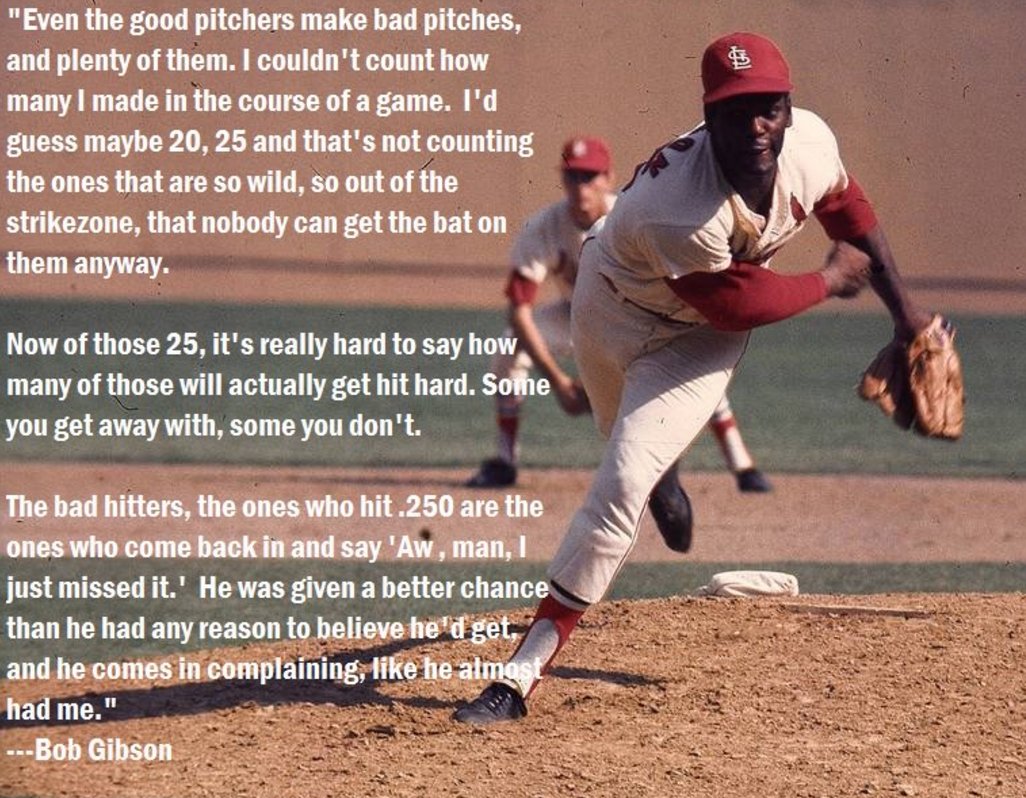 Bob Gibson made plenty of mistakes. But he threw with conviction.
You’re going to make mistakes – this is part of the game.
The best pitchers hold themselves to a high standard, constantly push to improve, but have the memory of a goldfish when it comes to competing. If you’re always beating yourself up about every missed spot, you will inevitably dig yourself into a mental ditch that you will be unable to climb out of. Pitching frustrated isn’t a viable strategy – understand that the best in the world make mistakes, and focus on controlling the only thing you can – the next pitch.
“Get over yourself”
Check out this interview where Kobe Bryant discussed how he flushed bad performances.
Surrender the outcome
Joshua Medcalf has an excellent book titled “Chop Wood, Carry Water” in which he shares a powerful story. Take a look:

If you go into competition with this mindset – that the end outcome isn’t fully within your control, then you actually maximize your chance of success.
When you aren’t worried about the past or the future, 100% of your mental bandwidth can be present in the here and now. With this mindset, you’ll have an easier time flushing bad pitches, at bats, innings or games – because you recognized up front that these speed bumps might happen. You recognized that all you can do is commit to attacking your process and competing one pitch at a time. Whatever happens from that point forward happens.
I once had a pitching coach tell the staff “your job is to compete like hell from the time you cross over the foul line until I take the ball out of your hand or the inning ends.” I think that’s the right orientation.
We’ll talk more about flushing when we get to the lesson on Red Light Routines.
Once you find a game-tested strategy for flushing the previous pitch, whether it’s telling yourself to “get over yourself,” “play the game,” reminding yourself to have fun, or imagining your mind emptying like me, hold on to that.
If you’re smart, you’ll lean on it for the rest of your career.
Intention [Click To Read]
Read time: 5 min
You toe the rubber and take the sign from the catcher. He signals for a curveball but you shake. He calls a fastball high and inside. You accept the sign. ‘Lets ‘effing go’ you think to yourself.
The intention phase is the brief but important phase in which the mental game plan occurs for the next pitch.
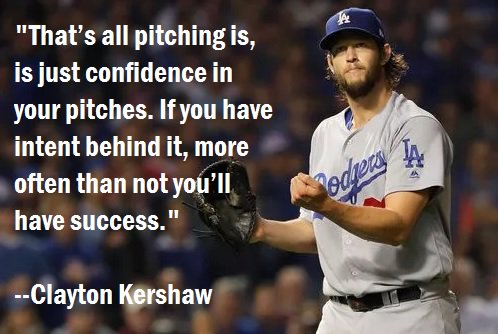
Clayton Kershaw on pitching with conviction
The key here is that you and your catcher are on the same page, and that you have 100% conviction in the pitch you will be throwing.
If you agree to a pitch that you are half-committed to, that’s unlikely to lead to a positive outcome.
You won’t execute 100% of your pitches perfectly – far from it. But you can aim to throw all of your pitches in your next bullpen or game with 100% conviction.
Once you and the catcher have selected a pitch & location, commit to it.
Nothing else in the whole world matters in that moment except that pitch you’re about to deliver.
Again, it comes back to conviction. The wrong pitch thrown with conviction usually beats out a better pitch call thrown without conviction.
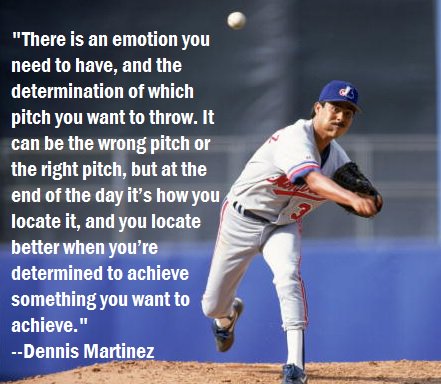
Dennis Martinez on committing to each pitch
Fake it Till You Make It
Conviction is easy when things are going well.
If you’re throwing a shutout or just struck out 2 batters in a row, you’ll probably be feeling pretty good about yourself. The mind and body will be freed up to slot into that flow state where you are fully present.
What’s tough is when things aren’t going well – and this is what separates the average pitchers from the great ones.
How do you stop from getting rattled and maintain conviction even when the game is closing in around you?
One option is to fake it till you make it.
I’ll elaborate more when we discuss the “Alter Ego,” but the idea is that you have to find a way to push that doubt and those feelings of vulnerability and weakness deep beneath the surface. This isn’t just to hide those feelings from the opposing team, but to hide them from yourself.
We all have internal dialogues, i.e. self-talk. This self-talk can be positive, building up a feeling of confidence & invincibility, or negative, reinforcing unproductive thoughts.
We don’t have direct control over completely eliminating 100% the negative thoughts, but we can turn up the volume dial of the positive self-talk.


Summary: The intention phase involves fully committing to the next pitch, regardless of the game situation. “Faking it” is a valid strategy to force yourself to learn to deal with pressure, dig your way out of jams and pitch with more conviction.
Visualize [Click To Read]
Read time: 4-5 min
You’ve committed to a high and inside fastball. You zero in on the top inner quadrant of the strikezone and you briefly envision a pitch tail from your hand through that spot for a swinging strike. You take a deep exhale and come set. You’re clear and relaxed, with the pitch path/focal point still echoing in your head.
What should be going through your head between the time when you accept the pitch call and when you actually release the pitch?
While the “right” answer is “whatever works for you,” we can draw upon both anecdotal as well as scientific evidence to help create some general guidelines and recommendations.
There are two main strategies that emerge when looking at what many of the best pitchers do.
The first is having a strong focal point (the catcher’s glove or body). The other is visualizing the pitch shape or “tail.” Some pitchers use a combination of both of these techniques.
Less advanced pitchers, especially ones who “spray” the ball and have zero feel for command, tend not to employ either strategy or skip this step altogether.
This is the “grip and rip” approach, which is no different from shooting a basketball at a hoop without focusing on the rim or swinging as hard as you can at a golf ball without focusing on the ball first.
Visualizing Pitch Shape/Tails
This strategy for improving command is to see the last 10 or 20 feet of ball flight in your mind’s eye just before beginning your delivery.
This is just like the pitch tails that most of you have likely seen PitchingNinja put out on twitter.

Visualizing the pitch tail can be a powerful mental tool
Here’s a clip of Daniel Bard describing how he used this technique to improve his command and return to the MLB after battling the Yips.
This type of visualization is not limited to pitching – here’s an excerpt from an academic paper discussing how visualizing ball flight is used in golf:
“Imagery [has been] shown to provide benefits in both full swing and putting performance in golf. The idea behind the utilization of imagery is to draw an imaginary line of flight that the ball may take toward the target location based upon the club that is selected and force that will be put into the swing.”
As Daniel Bard mentioned, he doesn’t necessarily do this on every single catch play throw, but he tries to in any bullpen or game pitch.
He also pointed out that this takes a good deal of mental effort to do, which doesn’t leave room for negative or irrelevant thoughts to creep in. Bingo.
Focal Points
Maybe visualizing pitch shapes isn’t your thing, but you’ll still need some strategy for how you attack a pitch location.
This is where focal points come in. In pitching, your focal point refers to where your vision and attention are concentrated.
Perhaps your focal point is always the mitt. Maybe it’s the catcher’s body as a whole. Maybe it’s the catcher’s face mask when you’re trying to dump a curveball in for a strike and the catcher’s glove when you’re trying to bury a 2 strike curveball.
Valiante (2005) suggests that golfers benefit when taking “fearless golf swings at precise targets.”
You get the idea – it’s essentially what you’re aiming at.

Soft vs Fine focus
Most of you have probably heard the phrase “aim small to miss small.”
On the flip side, most of you have probably also been told to “stop aiming” the ball when struggling to throw strikes.
So which is it?
The reality is that both can work, but that one will likely work far better for you than the other.
Soft focus refers to a larger focal point – like the entire catcher’s body. Fine focus refers to a smaller focal point, like the catcher’s mitt, his left shoulder, etc.
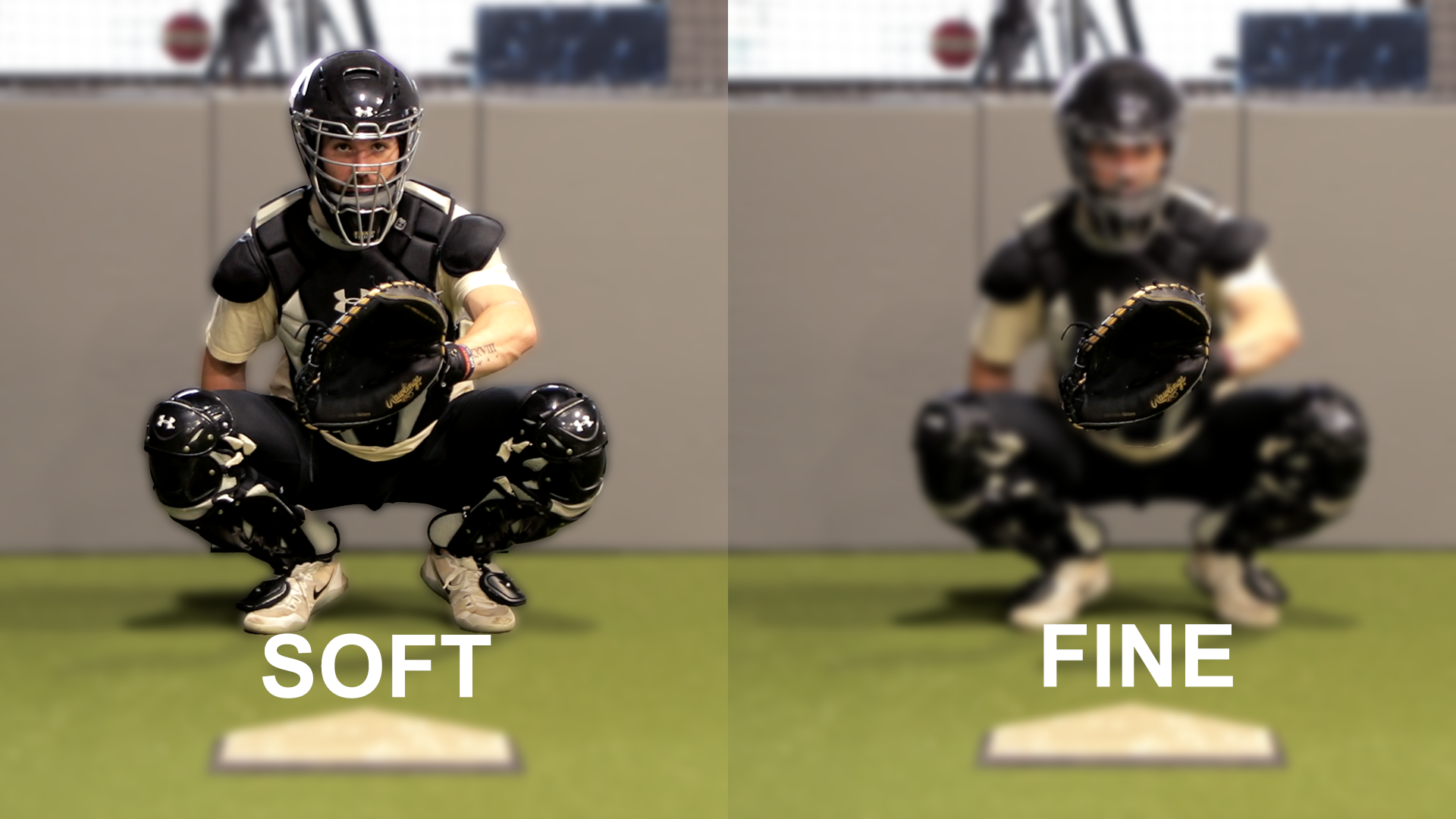
Aim small, miss small does genuinely work for some pitchers. But it isn’t exactly clear why some pitchers have success with this approach while others like myself struggled with it.
My Experience:
I was never comfortable with the aim small, miss small approach. I could feel myself aiming the ball, my command would worsen, and my stuff would always drop a few ticks. I felt myself losing that competitive, aggressive edge whenever I tried to be too fine – and I’ve seen the exact same in other pro pitchers too. While I don’t want to discredit that fine focus can work for some guys, I tend to err on the side of larger focal points and higher levels of aggression, especially for guys who are struggling with command over overthinking.
Here’s Tread athlete and MLB pitcher Pete Fairbanks sharing a similar perspective:
Focal points and the “Quiet Eye”
The quiet eye is term that researchers use to refer to where the athlete looks prior to executing their skill.
As one researcher stated,
The quiet eye is the final fixation or tracking gaze made before the initiation [of the skill] and is quite possibly the most well-studied vision strategy variable in sport. The quiet eye has been shown to be a key component of both expert ability and successful performance.
Essentially, elite athletes (NBA, Golf, etc.) tend not to be looking all over the place before a shot, and they usually have a more consistent focal point rep to rep.
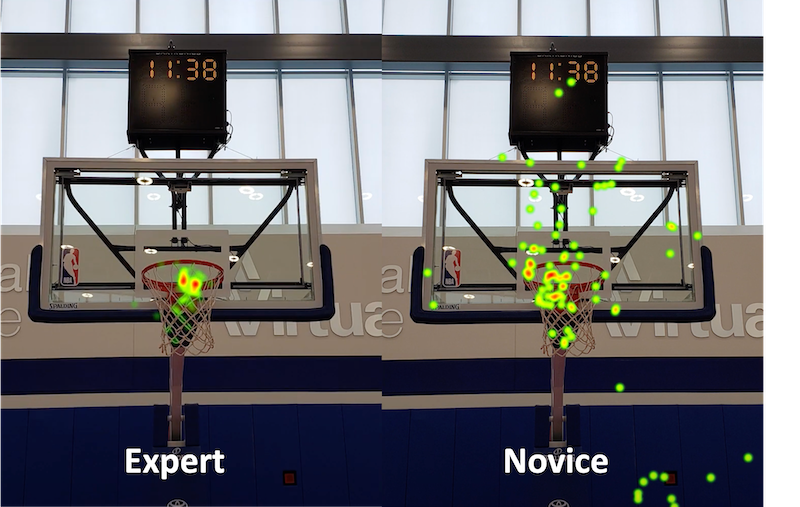
Here’s a video explaining this in more detail:
[Research is starting to be done on Quiet Eye in pitching – fun video of some data collection at TreadHQ.]
One word of caution is that this quiet eye phenomenon has not been validated in pitching yet, although there likely is some validity to it.
However, lots of successful pitchers do look down or away from the target at some point in their deliveries, and lots of successful pitchers have soft focus / throw to general areas as opposed to precise targets.

A ton of successful pitchers look down during their windup/leg lift.
As such, you can’t be 100% sure what is truly optimal for you without some experimentation.
Summary: Whether you visualize a pitch-tail, use a soft-focus where you aim to a general area (like the center of the catcher’s body), or use fine focus to aim at a precise target (like the catcher’s mitt), visualization/imagery is an important phase right before the pitch that has a huge impact on the resulting outcome. You’ll need to experiment some to figure out the best strategy for you.
Attack [Click To Read]
Read time: 4-6 min
This last phase doesn’t need much elaboration. Lift and go.
If you’ve prepared properly, you’ve controlled everything you can control and it’s time to trust the pitch.
An aggressive mantra like “blow it through the catcher” can help, although some pitchers perform better at a slightly lower level of aggression (certain pitchers will muscle up if they think 110% effort).
Here are a couple other clips that may help:
“Blow it through the center of the catcher”
I suggest opening up to soft focus and using an aggressive cue here for pitchers that are being too fine.
Clayton Kershaw – Aiming vs. Aggression
Credit: I Am Second
Kershaw suggests a similar approach – the majority of his intention is on throwing the ball as hard as possible, while in the back of his mind he’s holding focus on where he wants to throw the ball.
Notice how this is different from free-throw shooting. In pitching it can’t be 100% focus on location or you inevitably lose the aggression piece of the puzzle. Finding that balance – 80(%)-20(%), 90-10 or 70-30 is a process you’ll need to determine for yourself.

Optimize for throwing HARD strikes, versus selling out for only location or velocity.
The coaches who preach location only, keeping a perfectly still head, finishing in a good fielding position, etc. lose sight of the bigger picture which is that it’s not just about throwing strikes, it’s about throwing HARD strikes.
Many of these cues can rob several miles per hour from a pitcher. The key is finding the right balance between these variables where your stuff is both in the zone and electric.
Chase the Positive
If we think about NOT making a mistake, we become more likely to do it. Daniel Bard argues that we should focus our attention on what we want to happen by adopting an offensive vs defensive mindset.
My Experience
I experimented a lot and found that the Kershaw approach worked best for me. In college, I would catch myself coasting from outing to outing, sometimes taking my foot off the gas pedal without realizing it. My command wasn’t necessarily any better on these days, but I’d discover after the game that I was down 2 or 3 miles per hour and I’d get hit harder on these days. I made an effort from that point to make sure that when I crossed the foul line my mind was in attack mode.
The closest thing I can equate it to is right before you’re about to lift 90% or more of your max weight in the weight room. You intuitively know you’re going to get buried if you don’t hype yourself up beforehand. That channelling of all of your focus and intensity (neural drive) is a skill that applies to both the weight room and pitching as well.
Pre-Game Routine [Click to read]
Read time: 7 min
One of the big benefits of routines is that they allow us to put certain processes on autopilot so that we can allocate our mental energy to the things that matter, versus suffering from decision fatigue.
On game day, you don’t want to be wondering what time you need to get ready, figuring out what to do in your warm-up, etc.
Having an established pre-game routine will allow you to set much of this process on autopilot to make sure that you are fully primed and ready to go while still being mentally fresh & focused where it matters.
Your pre-game routine will be unique to you, but there are still some common themes that most successful pitchers abide by.
Keep in mind, there exist talented pitchers who “wing it” in regards to much of their training, routines and development, but this is exceptionally rare once you start examining Cy Young-Caliber pitchers.
These guys are dialed in, and everything they do is there for a reason.
Here are the general categories of your pre-game routine. It can and will change over time, but having some sort of established process will give you a base upon which to build.
Clubhouse routine
Your clubhouse routine includes everything you do on game day from the moment you get to the field.
This includes:
- Arrival time – do your best to keep a consistent routine that gives ample time to be prepared.
- Food – how do you time your meals / pre-game snacks? In college/HS, you’ll need to do most of the legwork here to be prepared. Generally, keep any large meals 3 or more hours before game time, and stick to faster acting carb & protein snacks pre or during the game.
- Training room – any pre-hab work with the trainers, hot/cold tub routine, etc.
- Scouting reports / game plan – when do you meet with your coach/catcher to go over any notes for the game?
- Relaxation – building in some time to chill out pre-game is important too.
- Suit up – knowing when to put on your uniform and turn off your phone. The turning off of your phone is generally the symbolic trigger that it’s time to get your mind into “game mode.” Nothing else matters from that point forward.
For relievers, you’ll likely have the same clubhouse routine every game, while for starters it will change depending on your start day vs. non start days.
For example, here’s Clayton Kershaw’s game day routine ⬇️
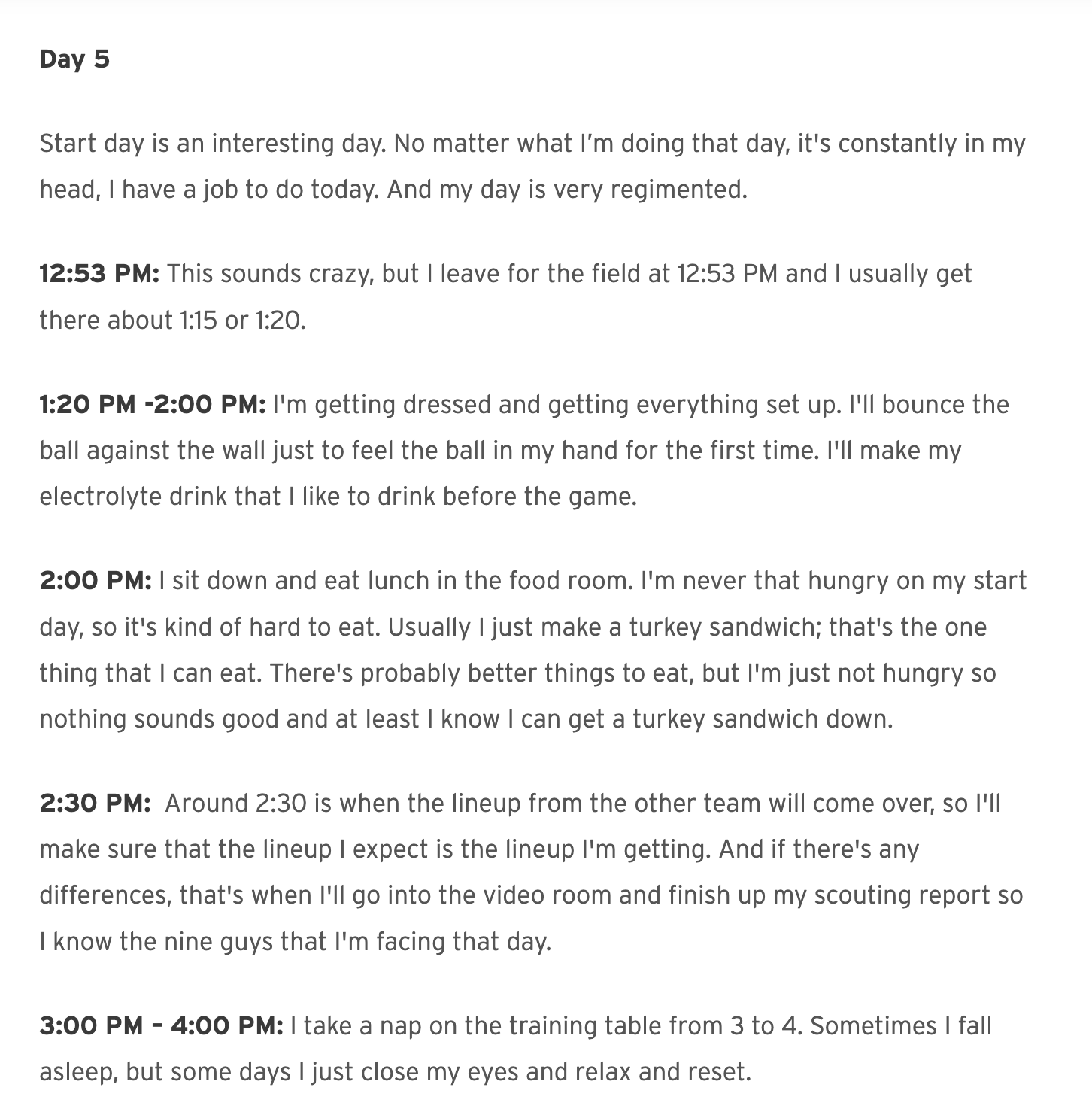
You can check out his full weekly routine here.
Dynamic warm-up and activation
This includes everything to get warm pre-game. If you’re training with us, your Tread coach will discuss the programming for this area.
- Foam rolling or tissue work – what areas need a little extra work to open up on game day? This could be feel-good modalities as well like the Theragun and Voodoo Floss, vs. aggressive soft tissue work.
- Dynamic warm-up / stretch with team – most relievers will do this part with their team on a set schedule. Starters usually have more leeway to time this on their own.
- Pre-game lift (if applicable) – some relievers prefer to lift pre-game. If this is you, keep the volume low to avoid creating much fatigue. A few sets of power work per body part can be potentiating, while 3 or 4 sets of 10 may induce fatigue and reduce performance.
Starters may have the luxury to have more extensive warm-up routines on game day, while most relievers will mentally exhaust themselves if they spend an hour rolling out every single game day. The goal is to find the sweet spot where you feel warm and your tissues are prepped, without being mentally exhausted before you even pick up a ball.
Kershaw’s dynamic warm-up & activation phase:
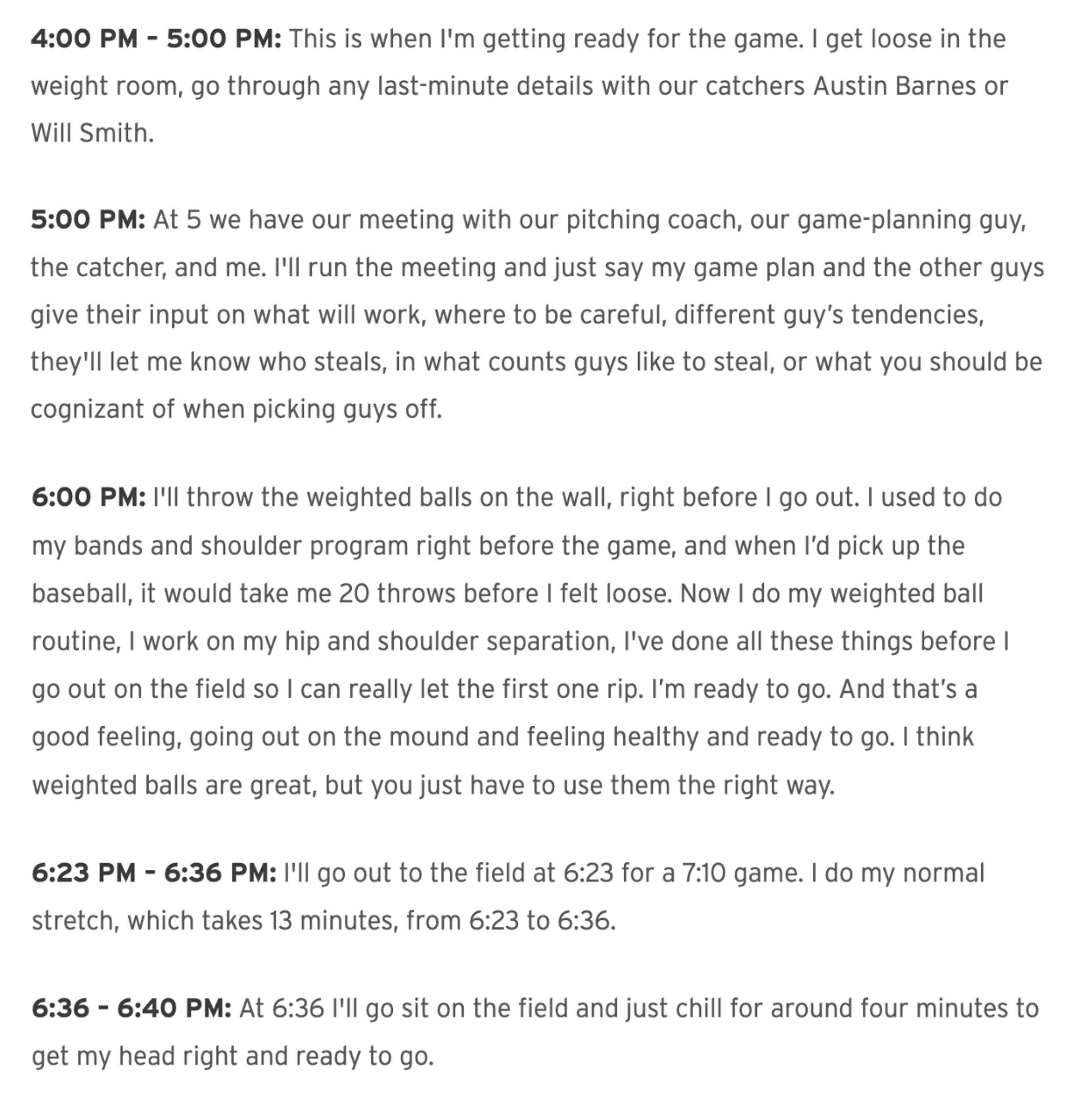
Catch play & bullpen routine
This includes everything from when you first pick up a ball until you go into the game. This will somewhat be programmed by your coach, but the specific details will be unique to you. This includes:
- Dry reps or feels drills – optional, but some pitchers like to hit some lower half drills or dry work here.
- Plyo or Weighted Ball drills – your sequence of drills to get the arm loose and work on patterning. Not every pitcher needs this phase. Be careful over doing it with volume and intensity here.
- Long toss – how far out do you throw? How long / how many throws?
- Bullpen routine – how do you structure your bullpen? How many pitches? What locations? How do you adjust things if a certain pitch feels off on a given day? Many inexperienced relievers will go way overboard here and throw 30 or 40 pitches before getting in the game. This is a good way to not make it through a long season. Establish the minimum effective dose for yourself – most commonly this is 12 or 15 pitches for relievers and 25-35 pitches for starters.
Here’s Kershaw’s catch play & bullpen routine: If this seems oddly specific, that’s actually the norm for top line starters. Check out Kluber and Degrom‘s routines.
What about relievers?
There’s a big difference here between starters and relievers. For relievers, there may be 2-3 hours between your pre-game catch play / long toss and when you get in the game.
Most relievers will keep the throwing very light pre-game, and maybe throw 5 or 7 pitches to a catcher in a short box to feel things out.
Once the game starts, starters and relievers will be using their intra-inning routines, which you can check out in the next section.
Here’s Daniel Bard going into detail about his pre-game routine as a reliever.
More examples
A few more examples to check out. Here’s remote athlete Kyle Wright, and his teammate Spencer Strider.
Routine vs. Superstition
While routines are important, be careful falling into superstition.
There will be times when things aren’t perfect – you have a sprained ankle, your pre-game routine is cut short, etc. While you should largely be able to stick to your pre-pitch routine in any situation, be aware that things won’t always go perfectly and you have to be able to adapt and adjust.
This is the point that Adam Wainwright makes here – he loves his routines, but he’s adaptable enough to handle the occasional curveball (excuse the pun) that the game throws at him.
Summary: Mapping our your game-day routine will help you focus on executing that routine with ruthless consistency.
Exercise 6: Pre-Game Routine
Complete the exercise entitled ‘Pre-Game Routine’ in your workbook. This will give you the opportunity to map out a standard pre-game routine for yourself. Unless you are a pro, it likely won’t be as elaborate as Clayton Kershaw’s, but this is one of the easiest pieces of your game to control to ensure that you are mentally and physically prepared before each outing. Don’t worry if it isn’t perfect, this routine is just a starting point that can be tweaked over time and further reviewed with your coach after completing this course.
In-Game Routine [Click To Read]
Read time: 5 min
Once the game starts, what do you do in between innings as a starter or reliever? As a reliever, how do you stay ready if your name is called? This is your in-game or intra-inning routine.
Intra-inning routine
While this will require some experimentation to establish, it’s an important topic to raise awareness about.
-Where do you go in the dugout between innings?
-Are you joking with teammates or completely quiet & serious?
-How in-tune to the game situation do you stay?
-What do you do if the half-inning goes long to stay warm/loose?
There isn’t a right or wrong answer here – it’s way more about preference and consistency.
Personally, I always preferred to sit away from my teammates and stay dialed in. I would try to clear my mind, relax, and (mostly) tune out the play by play of my offense. I wanted to mentally be ready to step back out on the field at a moment’s notice and knew I had no control over what my offense did.
A lot of younger players will ride the emotional ups and downs of their team’s offense, which I found to be distracting and pull me out of my zone.
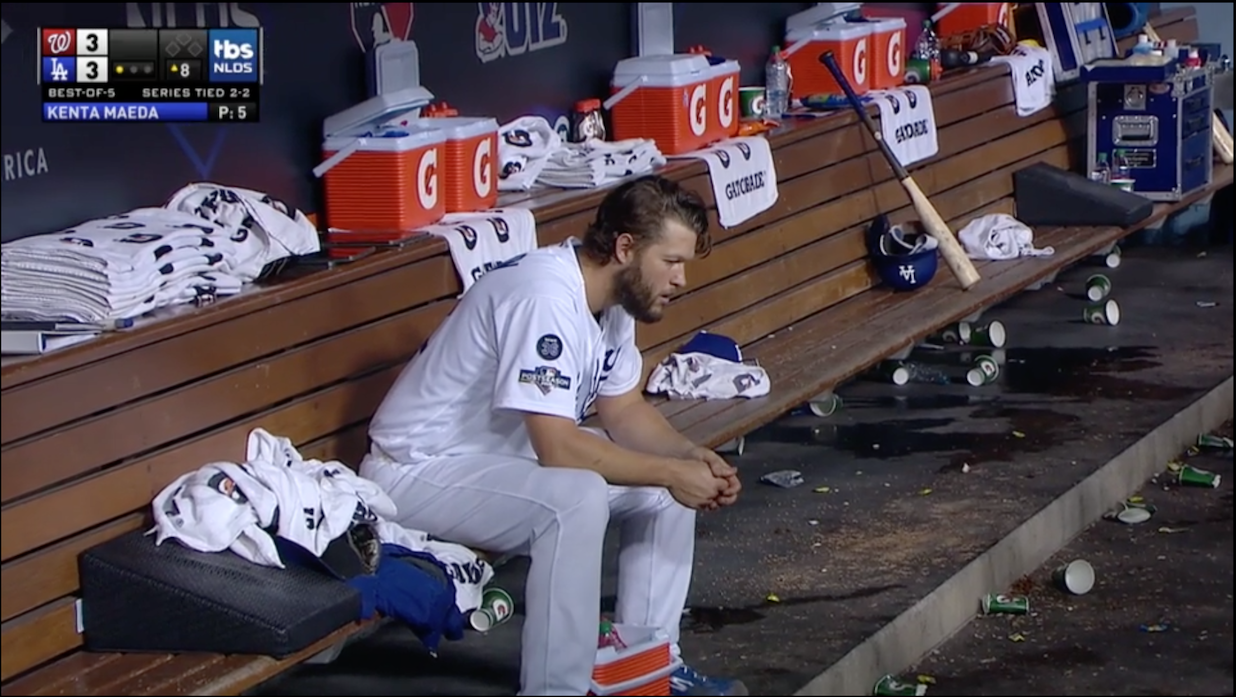 Do you sit in isolation or interact with teammates between innings?
I much preferred to stay in control, versus let the game dictate my emotional state. However, I know other pros who prefer not to sit with their own thoughts and would rather joke with their teammates during each half-inning. They had the ability to lock it back in when the half-inning was over and could dart in and out of that mode more easily.
For cold weather, make sure to stay warm. It doesn’t matter if that means wearing 3 jackets – your arm will thank you after the next long inning where your team puts up a 6-spot.
Don’t be afraid to head down to the bullpen and throw a few pitches to keep the arm moving as well if that’s what it takes.
You’ll have the opportunity to write down your intra-inning routine in the attached worksheets shortly.
Relievers – In Game Routine
You’ll notice that I’m not telling you what your routine should be, merely bringing up pertinent questions you should be asking yourself, so that you can flesh out and customize your own routine.
And perhaps none is more important for relievers than their in-game routine.
Being a reliever is inherently unpredictable – I’ve seen relief pitchers fill in for 5 inning spot-starts after a starter got hurt in the first inning, and I’ve regularly seen relievers come into the game with all but 1 batter to get hot.
As a reliever, you have to be ready when your name is called, which makes how you mentally and physically manage the course of the game that much more important.
You’ll want to construct an inning-by-inning plan that you can carry out throughout the game. The specifics will depend on your role (mid-long relief, 7th or 8th inning guy or closer).
Here’s a general outline of how this might look:
Inning 1-4:
Keep your body warm, stay relaxed, follow along with the game and interact with your teammates to keep the mood light. In high school or college you’ll likely be in the team dugout to start the game – in the pros you’ll start in the bullpen.
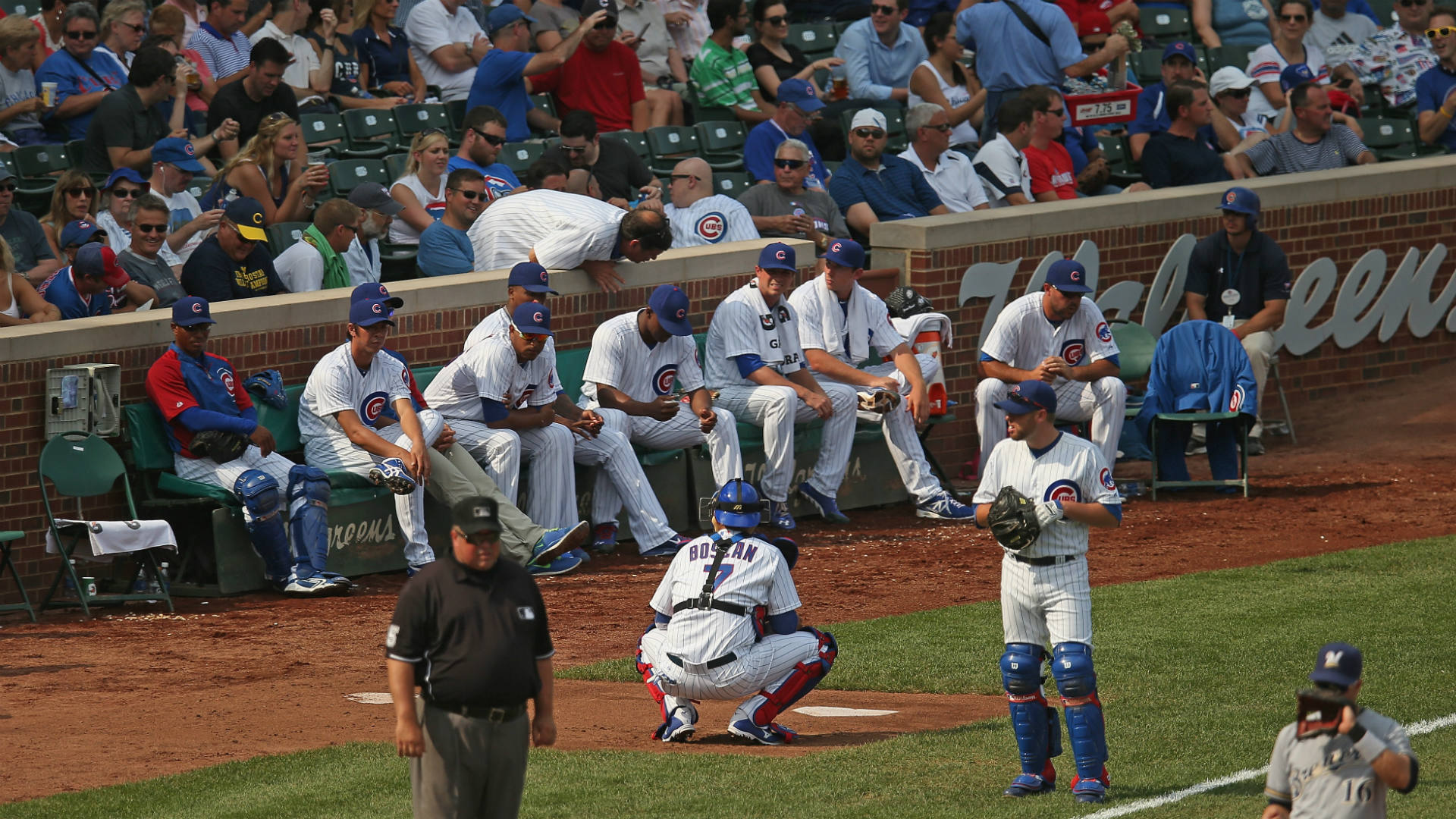
Top 5:
Head down the bullpen (HS / college) & perform a light dynamic warm-up to get body temperature up and get your legs warm.
Bottom 5:
Perform your arm-specific warm-up – arm circles, bands, shoulder tube, etc. Don’t fatigue yourself, the goal is just to get some blood flowing which you can then maintain easier over the next several innings if your name is called.
Top 6:
Play light catch or perform a few light plyo throws (10-20 light throws). Enough to feel your arm moving and know you’re in striking distance of getting hot if your name is called.
Inning 7-9:
Since you’re hot, the goal is to maintain this for the next ~hour in case your name is called. Every 15-20 minutes, hit a few arm circles or dynamic warm-up moves in order to keep the core body temp in a good spot. You should never feel cold and iced after the 5th inning for a game you may pitch. This is especially critical in cold weather games.
Managing to keep your body warm is one thing, but mentally staying dialed in from the 5th inning on (for most relievers) is the hardest part. You have to be ready to go at the drop of a hat, which can be very challenging especially if you haven’t pitched for 4 or 5 games in a row.
Staying mentally dialed in will allow you to take advantage of that opportunity when it does present itself, even if you’re not getting regular innings out of the bullpen.
Closers
One exception to this is closers who tend to have more predictability in terms of when they will pitch. They will almost always have a full inning of notice before they pitch because the game situation will dictate it, so they can plan out each piece of their routine by inning instead of having to be on standby from innings 6-9.
Get Hot Routine
Once your name is called as a reliever, this routine kicks in.
The Jolt of Life
Generally, there will be a pretty substantial burst of adrenaline that kicks in when you hear your name called.
You can interpret this in a number of ways – the natural tendency for some might be to interpret this as nerves or anxiety, while elite athletes will look at this jolt as excitement or energy that they can direct into dominating the batter.
I like to think of it as a jolt of life into the arm that helps tap into a superhuman level that you can’t access under normal circumstances.

Catch play & bullpen
Under normal circumstances, you’ll have ½ to a full inning of notice before you pitch, although it should really only take a ½ inning tops to get ready.
Hammer out a routine that includes a couple minutes of catch play, which may include a few reps of 1 or 2 key drills for you. For example, a couple rocker drills with the catcher in front of the plate. Then proceed into your bullpen.
The biggest mistake relievers make is throwing too many pitches in the bullpen. Your routine should be 10-15 pitches long – not 30 or 40.
Sample Pen
- Establish your primary pitch first – generally this means 3-4 fastballs. For example – FB middle, FB middle, FB in, FB away. Take 1-2 more if you need.
- Establish your secondary pitch – generally this means 3-4.
- Establish your third pitch.
- Throw a simulated hitter (optional).
My experience
In college I had to learn this lesson the hard way. I’d usually find myself constantly throwing “one more” in the bullpen until I’d thrown 30 or 40 pitches before every outing. One weekend I got hot 4 or 5 times, but never pitched. That Monday my coach asked why I was hanging – and I told him I’d probably thrown north of 100 pitches in the bullpen. MLB relievers conserve their bullets for the game and just take the bare minimum that they need to get hot.
Pitch-by-pitch
Once you’re hot and you’ve thrown your 12-15 pitches, if you know you’re going in the game the following half inning, you can stay on the mound and throw another pitch every 2 or 3 pitches from the game until the inning ends.
Many relievers like to finish on a firm FB right before they jog out on the field – whatever helps you feel the most dialed in and untouchable.
Entering the game – take your time
An area where young relievers screw up is in how they enter the game, especially for stadiums where the bullpen is in the outfield. You’ll have a long jog ahead of you, so make sure to keep it to a trot, and not a sprint to the mound.
If you run to the mound, you’ll have elevated your heart rate even more than normal, and will be spending the next 8 warm-up pitches out of breath trying to lower it.
I know this sounds silly, but relievers reading this will know what I’m talking about.
Watch how controlled Edwin Diaz is during his entrance. This isn’t an accident. He’s way more likely to be too amped up in this environment than not enough, so he’s consciously slowing things down to keep his heart rate and arousal in that sweet spot.
Accelerated Get Hot Routine
There will inevitably be a time when the game deteriorates quickly and you only have 1 batter to get ready. When this happens, this is when you go to your Accelerated Get Hot Routine. While other relievers would be frantically getting ready in this situation, you’re Cool as a CucumberTM because you’ve already prepared for this scenario.

Remember, you will generally have another 8 pitches on the game mound, so you will likely just have time to establish your primary pitch in the pen.
Sample Accelerated Routine
- Take 3-4 catch play throws to get the arm moving (i.e. 50%, 60%, 70%, 80%)
- Have the catcher get down
- Take 3-5 pitches to establish your primary pitch (i.e. FB middle, FB middle, FB away, FB in)
- Once your primary pitch is ready, signal to the dugout and the coach will begin walking out to make the change.
- During this time, take 2 or 3 more if you need it.
- Finish getting 2nd and 3rd pitches ready in your on-field warm-ups
Do NOT start throwing rapid fire during the accelerated get hot routine – it’s accelerated because you’ll be throwing less overall pitches, NOT because you’re rushing your mechanics and tempo. Young pitchers will start scrambling and throwing a pitch every 4 seconds.
Take the quality over quantity approach and get 3-5 well-executed pitches over 8-10 sprayed & rapid-fire pitches.
Remember, you are prepared for this scenario from your pre-game work and all of the work you’ve put into your craft this season. A shortened routine doesn’t mean you’re unprepared.
Separating the Bullpen from the Game
Sometimes, you’re going to throw a god-awful bullpen right before you go into the game. Sometimes you’re going to look like Cy Young in the bullpen. Don’t let your bullpen dictate how the outing will go – some of my best outings ever happened after terrible bullpens.
Be careful not to allow this to become a self-fulfilling prophecy. Shake off a bad bullpen and know that the game is a clean slate.
Summary: Ask yourself what your existing intra-inning routine is, and if there is any room for improvement. For relievers, make sure you can articulate your process, inning-by-inning, for how you get and stay ready. Learning to stay hot while also conserving bullets is a fine balance that relievers must master over time.
Exercise 7a & 7b: Intra-Inning & Reliever Routine
For this exercise, complete the worksheets titled ‘Intra-Inning Routine’ and for relievers, ‘Reliever routine’. These will help you map out what you do during the course of a game both as you prepare for a potential outing as a reliever or manage an ongoing outing once put in the game.
Red Light Routine [Click To Read]
Read time: 3-5 min
The traffic light analogy is one that I first came across in the book Heads up Baseball.
Green lights: this is when you’re coasting, everything is going well and you feel in control of the game. It’s go time.
Yellow lights: you let up a double, or walk a batter and feel some anxiety/tension building.
Red Lights: You walked back to back hitters and gave up a go-ahead bomb. The game has spiraled out of control and you can feel it speeding up on you.
Check out Michael Kopech in red lights below after giving up 4 home runs in 5 batters. About as understandable a time as any to feel this way.
Obviously, the goal is to spend as much time as possible in green lights, but realistically we need to be prepared for when the figurative 💩 hits the fan.
As such, you should have a pre-practiced routine that you can execute when you identify that you’re in yellow or red lights.
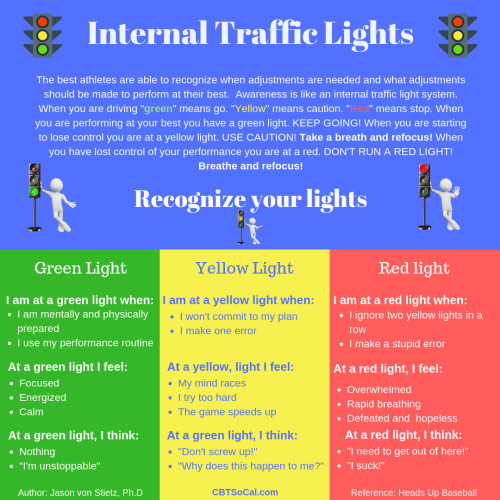
The Red Light Routine
Note: pro pitchers with the new pitch clock rules will not be able to implement much of this section without calling a mound visit.
The Red Light Routine is similar to the mini “flush” phase in your pre-pitch routine, but reserved for when that isn’t sufficient.
Here’s how it works.
Mentally, you’ll have some sort of reminder phrase to help shift your perspective and de-leverage the pressure of the situation.
Two powerful ways to shift perspective:
1. Lighten the mood
Reminding yourself to have fun or “play the game” as Daniel Bard does is a powerful way to de-leverage the situation and jolt your mind out of feeling sorry for yourself.
2. Embrace the challenge
Reframing this moment as an opportunity to work out of a jam or a challenge to overcome is another powerful way to jolt your mind into a new state. This is personally how I would deal with jams, by bearing down and getting hyper competitive for the next batter.
I love former MLB player Brandon Guyer’s simple cue for this: “Bring it on.”
Check it out:
Physically, you’ll also have a rehearsed part of this Red-Light Routine that you can perform to help temporarily shift the focus away from that home run you just gave up, and on to the next pitch.
It doesn’t matter exactly what this routine is, but I generally like to see pitchers
- Get off the dirt and onto the grass
- Turn their back to the plate
- Pick up a consistent focal point that will be at any and every stadium (like the top of the left field foul pole)
Sample Red Light Routine
For example, stepping completely off the mound, taking off your hat and picking up the top of the foul pole.
Take a deep breath with slow exhale.
Relax the face, and feel the last play melt away. Put your hat back on. Bring it on.
Turn around invigorated and walk up to the rubber ready to go.
Do not turn around, get back on the mound and toe the rubber until you’ve felt that reset. When your cleat engages with the rubber, it’s go time.
If you’re going to feel sorry for yourself, get off the mound, give yourself a few seconds to do so, and get back to work.
Believe it or not, this is something that you should practice periodically so that it’s second nature in the moment.
We’ll talk more about training these routines at the end of the course.
We’ll end this section with a clip from the 🐐 Justin Verlander, where he discusses his thought process after giving up a home run and then putting together a solid start.
Listen in:
“Immediately once that happens, you have to turn the page. I’m not going to let that ruin my day. Let’s pretend it’s 0-0 and go from there.”
He deleveraged the situation, kept perspective, and focused back in on what he could control:
The next pitch.
Exercise 8a / 8b: Traffic Lights & Red Light Routine
Find and complete the ‘Traffic Lights’ and ‘Red Light Routine’ exercises in your workbook. Your release should be unique to you and be something that can take place in a 5 or 10 second window between batters.
Pre/Post Outing Worksheets [Click To Read]
Part of applying the mental game is having a well defined plan going into a game, and then taking a few moments to debrief how that plan went after each outing.
Flip to the exercise in your worksheet entitled ‘Pre/Post Outing Worksheet’
Here we have prepared a worksheet that you can fill out before and after each game.
Pre-game, you’ll write down up to 3 process-oriented goals.
Post-game, grade yourself from 1 to 3, 3 being the highest, on how you did at sticking to this process, as well as 7 other factors. Your final score will be out of 30 total points, and will serve as a measuring stick of how well you implemented the mental game this outing, regardless of the Box Score.
We have filled out a sample worksheet for you, with a blank printable one on the following page. Consider printing multiple copies that you can fill out before/after each future outing.
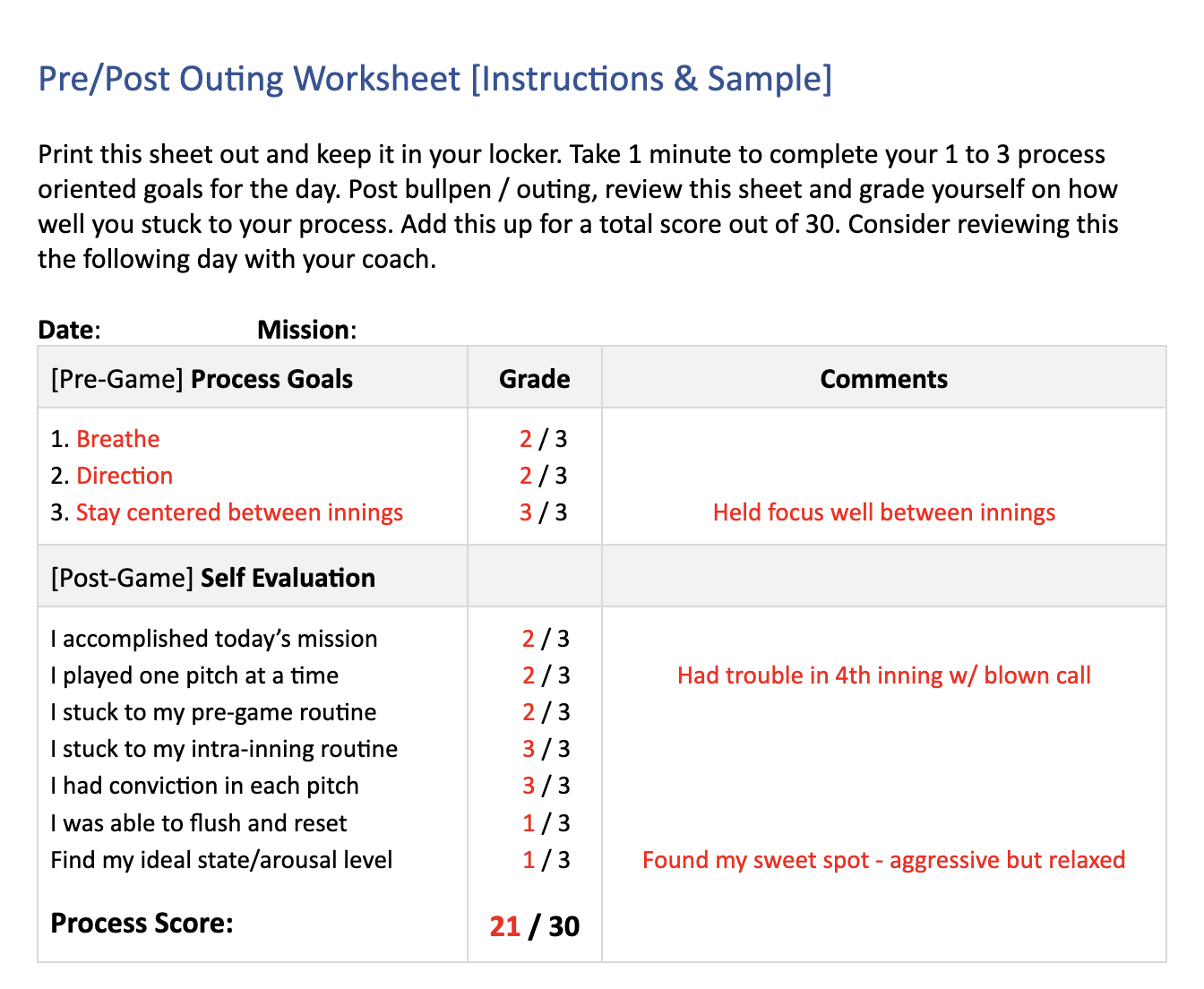
Exercise 9: Pre/Post Outing Worksheet
Flip to this exercise in your worksheet – no need to complete it now, but consider using it for your next outing or bullpen.
Intro To Breathing Techniques [Click to read]
Read time: 5-7 min
Most pitchers are familiar on some level with breathing as it relates to performance. The issue, similar to routines, is that many haven’t fully applied this powerful technique to their own routines.
For me, applying intentional breathing required first having an understanding of the purpose and science behind breathing as it relates to performance.
A Versatile Tool
Breathwork has been used for centuries in various forms (since at least 500 BC) – most notably in different forms of meditation. This is most commonly observed in present day Yoga practices, although the practice of different types of meditation is growing in popularity in the western world as well.
The breath is often regarded as a way to “center oneself” or “clear the mind”.
This was an abstract concept for me to grasp until I’d been exposed to simple meditation practices – and felt how still and clear the mind can get – at which point I recognized the potential of incorporating the breath into a pitching context.
While people of all walks of life can benefit from clearing the mind to deal with anxiety, intrusive thoughts or stress, athletes have also been picking up on this as a performance enhancing tool over the past several decades.

Many pitchers in the big leagues have similar stuff to minor leaguers, but are more consistently able to perform at their peak. In part, this is because they can better navigate the pressure and stay present while pitching.
The breath can serve an important role in this.
Check out how some of these MLB pitchers incorporate the breath into their routine
The Science of Breathing
All of us breathe, but there are actually different types of breathing, which can have very different effects on our nervous system.
Our autonomic nervous system has two main states: Sympathetic and Parasympathetic
Sympathetic nervous system
When we’re in a sympathetic state, our body is in “fight-or-flight” mode. Our heart rate goes up, our breathing becomes more rapid, our stress hormone cortisol spikes and adrenaline starts pumping as our body prepares to deal with a perceived threat.
On the one hand, this is a good thing when we’re trying to lift a max weight or our ancestors were trying to run away from a bear, but as pitchers it can be detrimental when we get too amped up that we lose the ability to focus (pitchers often describe this as “blacking out”).
Rarely should you be in a 10/10 state of arousal on the mound. There exists a sweet spot for each individual where performance is maximized.
The inhalation phase (especially rapid chest inhalations), is associated with the sympathetic nervous system while the exhalation phase (especially long, controlled exhales) is associated with promoting the parasympathetic nervous system.

Breathing can regulate our nervous system.
Parasympathetic nervous system
When we’re in a parasympathetic state, our body shifts more towards “rest-and-digest” mode. Our heart rate slows, blood pressure drops, breathing slows, and recovery is able to take place.
Ideally we can tap into this state easily outside of training sessions and competition to maximize recovery. However, even during competition we may need to further tap into this state using deep breathing to regulate our arousal from getting too high.
It has been shown that the average heart rate during a game for pro pitchers is ~85-90% of their max. With a tendency to already be in quite a heightened state of arousal, most pitchers will likely find the parasympathetic breathing strategy to be the most useful.
Applying breathing in practice
While there are many different breathing practices in meditation, here is the simplest way to apply it in a game or bullpen to your routine.
Standard breath
As you toe the rubber or come set, building in a simple, intentional belly breath with a 1-2 second inhale and 1-2 second exhale will serve as a placeholder to clear the mind and give you something to center your focus on.
Relaxing breath
If you feel yourself starting to speed up, slow down the exhale to 4-6 seconds (again, may be difficult now for pros with the pitch clock). Because the exhale promotes the parasympathetic nervous system, it will help to slow your heart rate and promote the type of brain waves (theta) associated with flow state. (1)
Rapid / Double breath
If you feel yourself dragging before an outing or in the bullpen, you can use rapid inhalations to promote the sympathetic nervous system. This may be necessary for morning games, or when you can tell that your arousal level is too low. Here’s a video tutorial on Double Breathing.
Check out a simple explanation from Daniel Bard discussing how he uses these different types of breathing in practice:
Summary: You can use deep belly breaths with a slow exhale to slow your heart rate during a game and center your mind, while rapid chest breaths will help to excite your nervous system. Building in an intentional breath into your pre-pitch routine is also a powerful tool to flush the previous pitch and refocus on the present.
Understanding Arousal [Click To Read]
Read time: 5-7 min
What is Physiological Arousal?
Arousal refers to the how mentally and physically activated an athlete is during competition.
In reality, arousal refers to the activation of different parts of your nervous system. Namely, the fight-or-flight side of your nervous system (sympathetic) or the rest-and-digest side (parasympathetic).
The best performers can regulate their arousal and stress response to not get too amped up in pressure situations, while at the same time making sure that they don’t get too low at times either. More on this below.
The following graphic depicts what this looks like when someone is in a fight-or-flight vs rest-and-digest state.
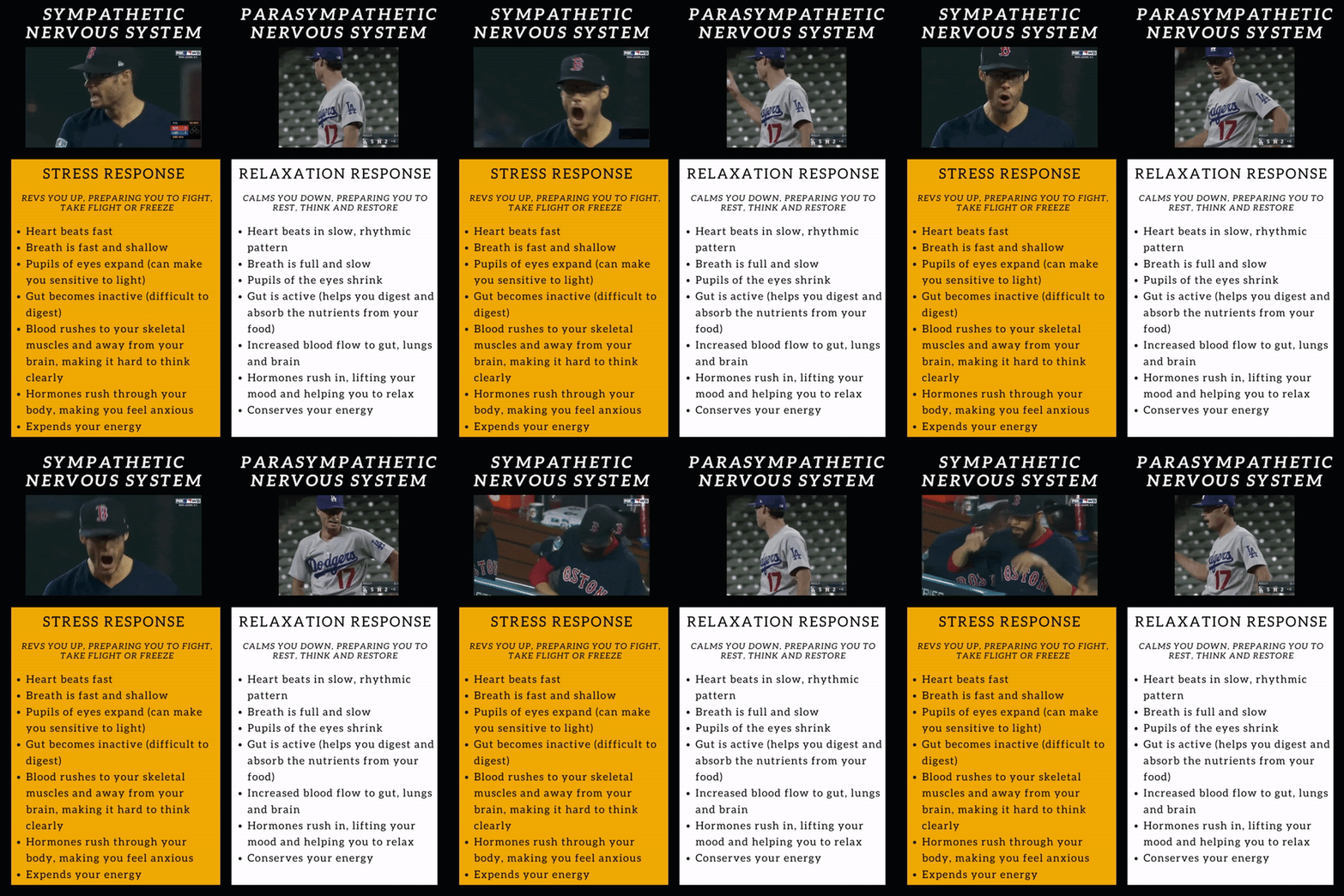
In an overly aroused state, athletes can feel a rush of anxiety, uncontrollable heart rate, nervousness, jitters, inability to relax, and an overall loss of proprioception and control.
During these periods the overly increased heart rates and breathing rates make it harder to perform both physically and mentally. Having strategies to decrease arousal rate are important for these athletes and in these environments.
We can all think of times when we were too aroused in game. I can remember my hands shaking during my first college outing against University of Texas in front of 10,000 fans. When players say they “black out” this is generally the state they were in.
It’s not particularly ideal for performance to be this amped up.

What does insufficient arousal look like?
Due to the negative connotations of the overly aroused, increasing arousal rate may seem counter-intuitive. In fact, traditional sports psychology often recommends controlling arousal and anxiety to create a more relaxed state.
However, while research does show that being relaxed can improve performance in some contexts, there are times when an athlete may need to increase their level of arousal.
We can also all think of games when we were dragging our feet. You probably felt like taking a nap, or like your body was moving through molasses.
While you were relaxed, this is also not an ideal state for maximum performance.

Increasing arousal is desirable in this context, and in fact many pitchers perform better when their arousal levels are towards the higher end of the spectrum despite the tradeoffs.
The Sweet Spot
There is a bell curve relationship between performance and arousal which is called The Yerkes-Dodson Law. Researchers further expanded on this idea by suggesting that this relationship is actually unique to the individual.
As discussed above, athletes will have a sweet spot of arousal which, for them, corresponds to optimal performance. Essentially, the goal is to figure out where you need to be on this bell curve to achieve optimal performance. This would be considered your “Zone of Optimal Functioning.”
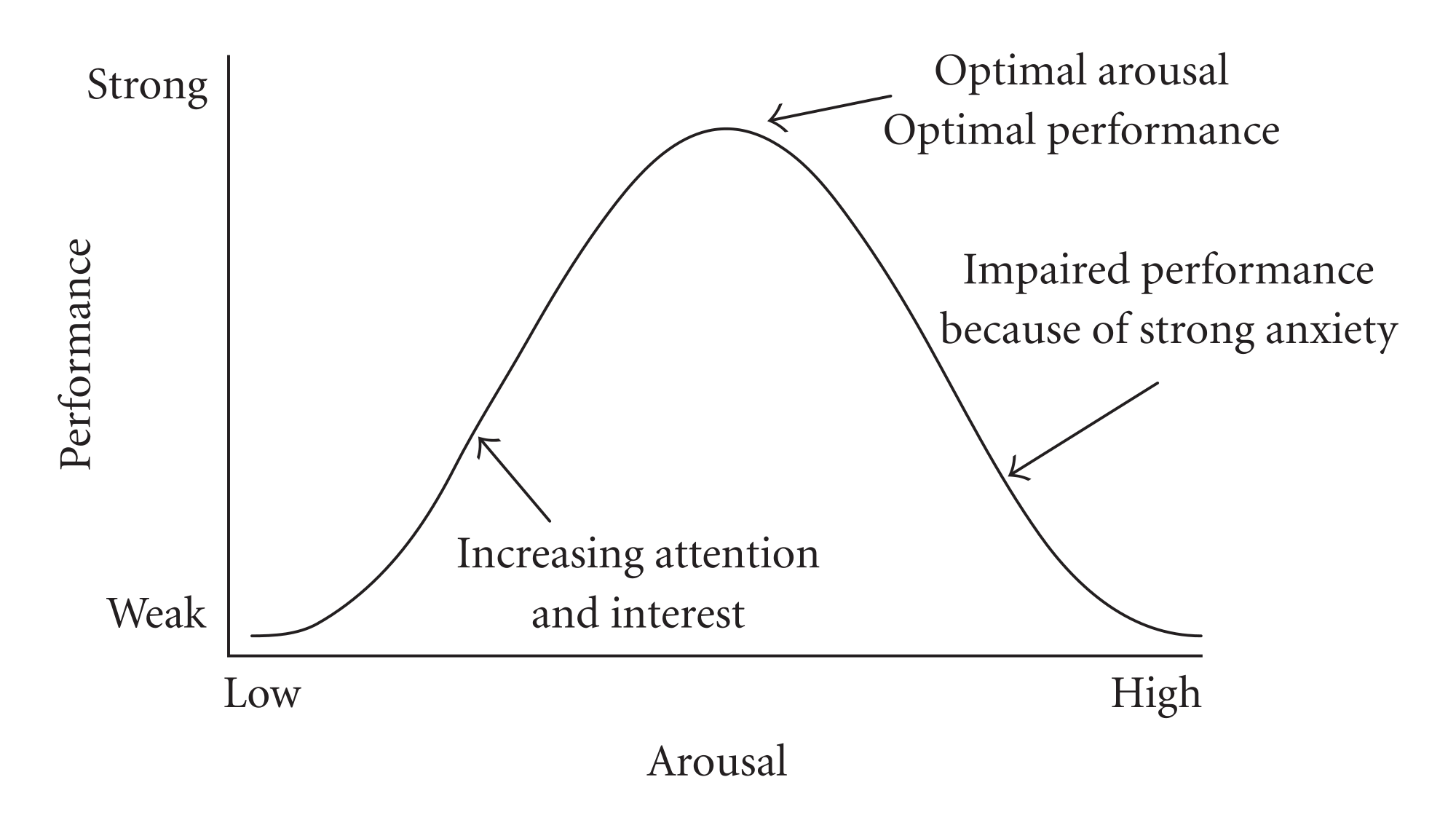
Some sports, like powerlifting, may reward higher levels of arousal, while others, like sharp-shooting, may reward lower levels of arousal. So this sweet spot is really a moving target that will be different based on the sport, position, and athlete in question.

Practical Examples
Take a look at two Cy Young pitchers with very different zones of optimal functioning: Max Scherzer & Corey Kluber.


Kluber is surgical. Precise. Calm. Focused.
Scherzer is aggressive. Angry. Amped. Dominant.
Would Scherzer perform better if he was told to “calm down,” lower the arousal and pitch in a less “fired up” state? Unlikely.
What about if you told Kluber to get hyper aggressive and amped up?
Over time, through experience and trial & error, athletes can learn what state of arousal maximizes performance and gain the ability to self-regulate their arousal as needed.
This is the golden ticket that we’re after.
Increasing Arousal
Here are a few tools you can use to increase arousal. This is by no means an exhaustive list, but is helpful when you can tell your arousal level is too low.
Wim Hof Breathing (sometimes called Cyclic Hyperventilation or Double Breathing)
A specific breathing technique that alternates sharp exhales with sharp inhales to increase brain oxygenation and overall arousal.
These breaths are opposite of traditional relaxation breathing and using secondary respiratory muscles within the upper thorax can increase your arousal by activating the fight or flight response. Andrew Huberman explains below.
Affirmations/Self-Talk
Utilization of specific mantras and cues that stimulate an aggressive mindset. Ex: “Attack this hitter. Throw it right through the catcher. Etc.” These can be done away from the field in a scripted sense or they can be words, phrases, or thoughts that you develop to get into the proper frame of mind pre game or in between innings. These can be highly individualized and it may take practice to identify the words, affirmations, or statements that help you reach an optimal arousal state.
Music (pre-game)
Ex: Listening to loud, upbeat songs that specifically increase your energy levels. Fast paced music in particular has been show to increase heart rate and arousal without movement.
Dynamic Warm-up/Potentiation
Using physical activity and/or CNS activation exercises. Take note of what types of warm-ups seem to get your body “going”. If there are particular movements or exercises that seem to elevate your adrenaline make sure you use those at times when your arousal levels may be lower than desired.
Visualization/Imagery (pre-game)
Visualization or imagery can be used as a means to mentally lock into a task you’re about to complete. Prior to competition you can imagine yourself dominating your opponent. For some, this might increase arousal states. Practice visualization away from the field and in a practice setting to identify the best method for you.
Acting Energized
The simple act of physically forcing yourself to behave with energy can increase breathing rates and heart rates, in turn elevating states of arousal. Bouncing, jumping, or just acting “hype” with your teammates can be enough to amp you up.
Caffeine (pre-outing)
This potent stimulant will increase arousal, but careful going overboard. Too much may decrease performance & impact sleep/recovery.

More info on each of these tools in the personality profile presentation.
Decreasing Arousal
On the flip side, some athletes perform better in a lower state of arousal and may need to calm themselves down if it gets too high. Here are a few tools:
Music (pre-outing)
While upbeat music can have an energizing effect on the body, slow paced music can do the opposite. It’s important to understand the difference between music that creates sadness and music that creates peace or tranquility. We are looking at beats, tones, and lyrics that promote focus, calmness, and confidence.
Limit caffeine
In a high arousal environment, taking excess stimulants can be overkill.
Deep/Diaphragmatic Breathing
Inhale through the nose into your belly with a slow exhale through the mouth to lower arousal. Much like PMR, deep breathing provides relief to your nervous system. Deep breathing is powerful tool because it can deployed at any time and can be extremely helpful in the heat of competition.
Similar to the deep/diaphragmatic breathing, but involves a double nasal inhale followed by a slow exhale for 1-2 rounds.
Meditation (pre-game)
Using meditation as a mechanism to calm down and lower overall arousal.
Using Pre Game & Intra Game Routines
Routines can be used as anchors and help athletes to determine, analyze, and regulate their current levels of arousal. Routines provide comfort because they are always there. Using pre game routines reduces stress and anxiety through giving athletes a means of complete control. Pre and/or post pitch routines provide a similar safety net.
Progressive Muscle Relaxation (pre-game)
Deliberate focus on tensing and relaxing muscles in a specific order (i.e. head to toe). The premise of PMR is to contract and relax each muscle in the body sequentially, starting at the feet or towards the head. PMR releases tension in both the nervous system and muscular system, which can have multiple performance benefits, especially for athletes that perform best on the lower portion of the arousal continuum.
Flush Routine
The ability to flush bad thoughts or pitches is based on mindfulness, the ability to identify your current physical state and mental state and observe/detach from those feelings without judgement.
Example: giving up a leadoff double, a fleeting thought “oh sh*t” flicks through your mind and you feel your heart rate speed up momentarily. You detach from that thought and that outcome, and refocus on the next pitch.
Summary: The best athletes can reliably get into their optimal state of arousal. This is a prerequisite for peak performance. Understanding this concept and gaining awareness of your arousal level will help you learn to regulate it using some of the tips presented throughout this course.
The Alter Ego [Click to read]
Read time: 5-7 min
You may recall from earlier that one way to gain conviction is to “Fake it”
Some of the best athletes, and even musicians and entertainers, take this a step further by constructing separate personas to deal with the pressure of competition / performing.
The alter ego is a mental strategy that can be used to better compartmentalize our emotions/feelings.
Outside of the field, we are all dealing with a variety of personal challenges – family, relationships, etc. In competition, there is no room for doubt, anxiety and indecision – so constructing a persona that is “immune” to these things is one approach to trick ourselves into coping with the pressure.
Examples of the Alter Ego
Examples of the alter ego are everywhere.


The Black Mamba
In basketball, Kobe Bryant created his alter ego “Black Mamba.” He did this when the outside noise and distractions started to get too intense – and used this as a way to compartmentalize his on court persona from his off-field one.
Kobe chose the Black Mamba because it’s the fastest and one of the most deadly snakes in the world, and it strikes its prey repeatedly with 99% accuracy. When he was the “Black Mamba”, he saw himself as a deadly predator that could pick apart his prey with extreme precision and accuracy. You can listen to him talk about this here.
“Goggins”
Former Navy Seal David Goggins created “Goggins” for when he needs to push through hard exercises or challenges.
Jekyll and Hyde
In literature, the most famous is example is Jekyll and Hyde, where Dr. Jekyll has to contend with his dark side, “Mr. Hyde.”In comics / movies, most Superheros have alter egos. Clark Kent transforms into Superman, Bruce Wayne transforms into Batman, and Bruce Banner turns into the Hulk.
Flipping The Switch
Whether or not you carefully construct and name an alter ego for yourself (which may sound crazy to you), you can still apply the same concept of flipping the switch.
Having a “game face” is a much more common way to describe this personality change that top athletes go through.
In my coaching experience, this is even more necessary for “nice” guys, who don’t always naturally have that same confidence, swagger and aggressiveness.
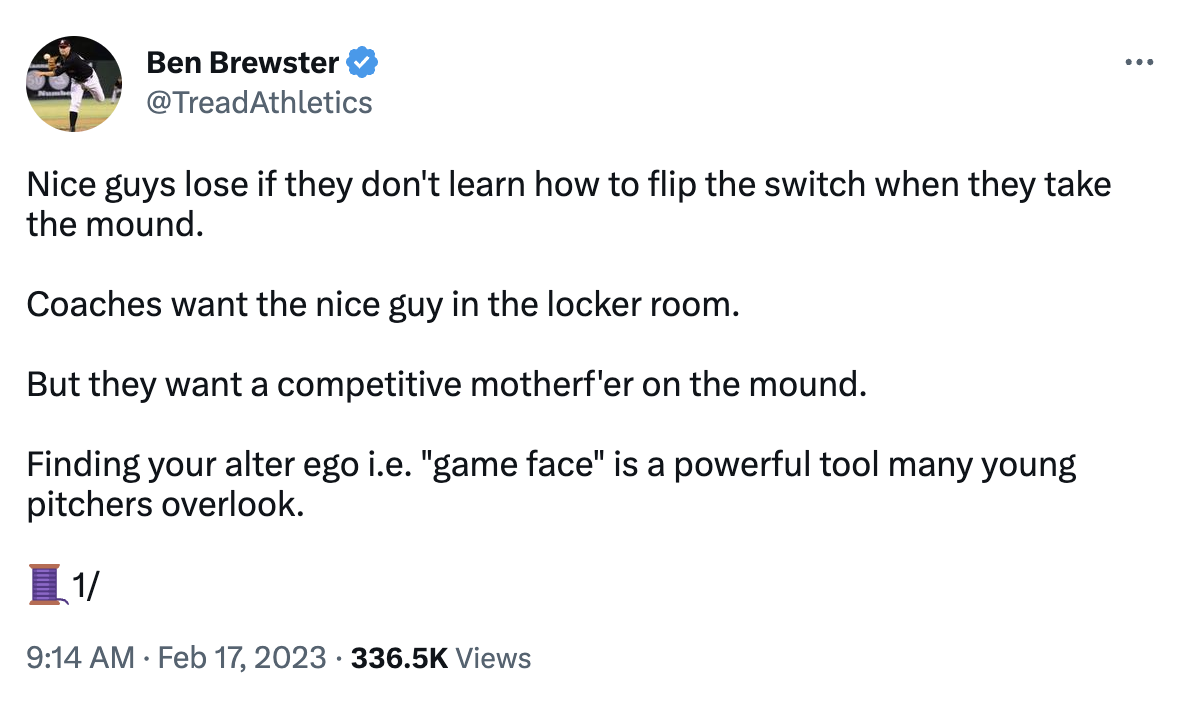 Check out the full twitter thread here.
For me, my in-game persona was a conscious choice that I made one day. I would tell myself that the batter was trying to take something from me, using this to light a bit of that competitive fire.
In between innings instead of allowing myself to feel anxious about going back out there, I would imagine that I was eager to get back out there, like a caged bull ready to charge as soon as the gate comes up.

Here are some additional examples of how Chris Sale and Pedro Martinez changed their personalities when it was game time.
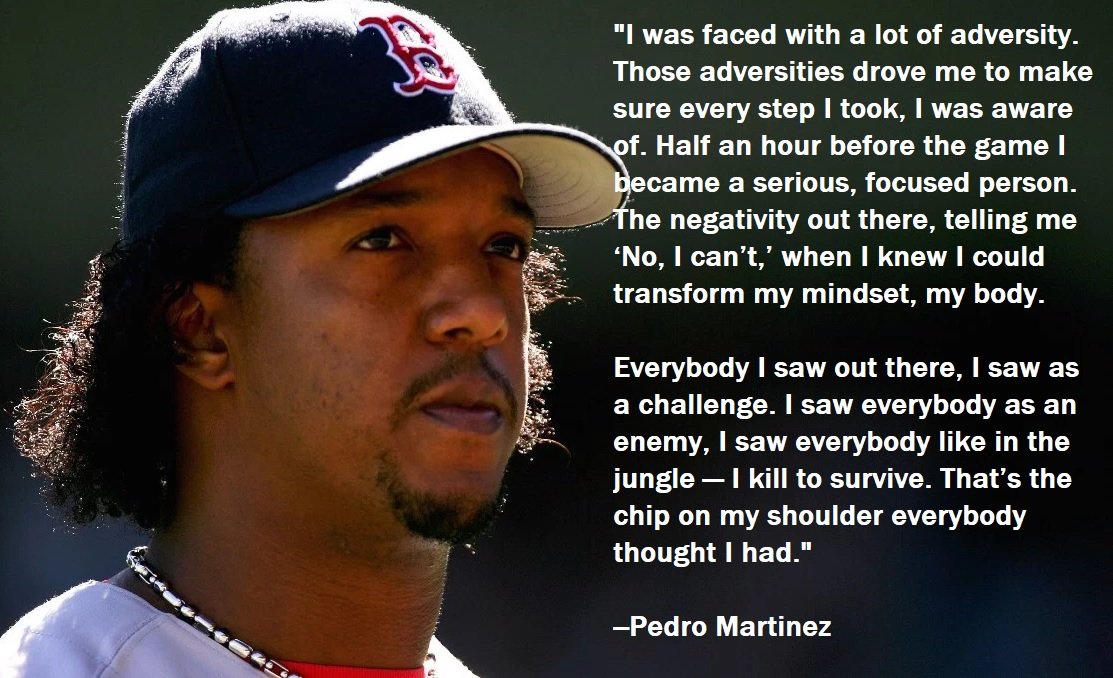
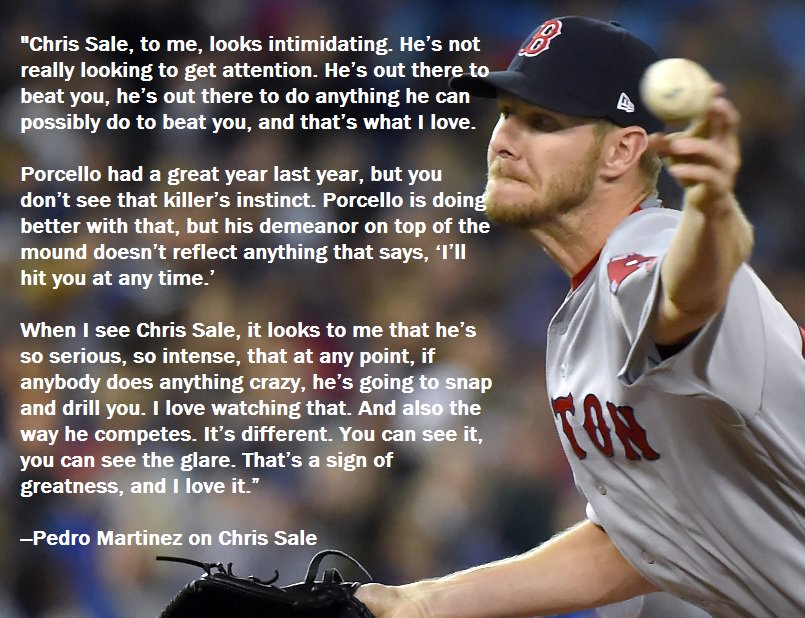
If you struggle to flip the switch, the first question to ask yourself is what mentality tends to yield the best results for you.
Not everyone needs to be hyper aggressive like Max Scherzer or Nolan Ryan. Maybe you perform better with a calm, focused intensity like Corey Kluber.
The key is to find the balance that works best for you and have a consistent approach to get yourself into that mindset pre-game and in between innings.
In many ways, the alter ego is like a mental armor you can put on before competition to become the most dangerous version of yourself.

A Big Game Pitcher
“You are what your brain tells you you are.” – Adam Wainwright
One of the relievers we’ve had the opportunity to work with is Josh Hader. I asked him about his mentality, as he has been one of the best relievers of the last 5 or 6 years.
One of the things that stood out to me is that he has crafted his identity to be a “big game pitcher.”
What I mean by this is that he feels (believes) he is better under pressure, not worse. By identifying as a big game pitcher, he turns those moments into a strength for him rather than a weakness.
This is another version of the alter ego and of changing your perspective to reframe the challenge in your mind.
Exercise 10: Creating An Alter Ego
Please complete the corresponding exercise in your worksheet, entitled “Creating an Alter Ego.” This exercise will help you think about what a theoretical Alter Ego for yourself might entail. Consider what your in-game persona is, and if it’s where it needs to be to maximize your performance.
A Simple Gameplan [Click To Read]
Read time: 2 min
While this topic doesn’t exactly fall under the “mental skills” category, it does tie in as a factor as to why many pitchers get paralysis by analysis. This can then absolutely become a mental issue.
One of the best ways to free yourself up on the mound is to have established an understanding of your arsenal and have a simple game plan. This doesn’t mean you won’t have a slightly different approach to specific hitters in the lineup, but generally things don’t change drastically from lefty to lefty or from righty to righty.
Here’s MLB closer Pete Fairbanks talking about this shift in mentality:
Example 1: Clay Holmes
For example, here are some heat maps our data team created showing Clay Holmes’ expected run value for all pitches & locations against the Rays’ lineup. As you can see, it doesn’t change that much batter to batter.
In many ways, his gameplan can be as simple as a healthy dose of sinkers down in the zone, along with throwing his gyro and sweeper sliders glove side. He can prioritize the sweeper to righties and the gyro to lefties, making adjustments for any outlier hitters as necessary.
Example 2: Justin Verlander
Here are Justin Verlander’s pitch locations to righties and lefties.
Fourseam: he throws it up and really up when he needs a whiff.
Curveball: he throws it for a strike in the bottom ½ of the zone and a bit down for a whiff.
Slider: He throws it glove side on the black or just out of the zone for a whiff
Changeup: he throws this very sparingly low and arm-side

This is his game plan in a nutshell. It’s simple and effective.
Throw your best pitches the most and throw your stuff where it plays the best.
As long as the catcher is up to speed on the plan, the pitcher (you) can be more freed up to just focus on executing it.
Summary: Keep your gameplan simple. Throw your best stuff more, to general locations where they play the best. Talk to your coach if you need help establishing this gameplan.
Exercise 12: My Gameplan
Go ahead and complete the corresponding worksheet. You should be able to clearly articulate your gameplan to lefties and righties accordingly.